A common saying around the restaurant industry is “people eat with their eyes”—that is, people are drawn to meals that look as great as they taste. A similar motto holds true in home remodeling: people buy with their eyes. That means that in order to attract a larger customer base, you have to provide some visual proof of the quality of your jobs.
As a contractor, you’re actually lucky in this regard: your work naturally lends itself to visual interest. It will be easy for you to give potential customers a taste of your offerings simply by showing off before and after photos of a project. Your online portfolio provides a quick, easy-to-digest snapshot of your services and your craftsmanship. But there’s a lot more to it than that. Pictures can expand your online reach and improve your web presence. Here are some of the potential benefits of before and after photos—and how to take better pictures for your digital outreach.
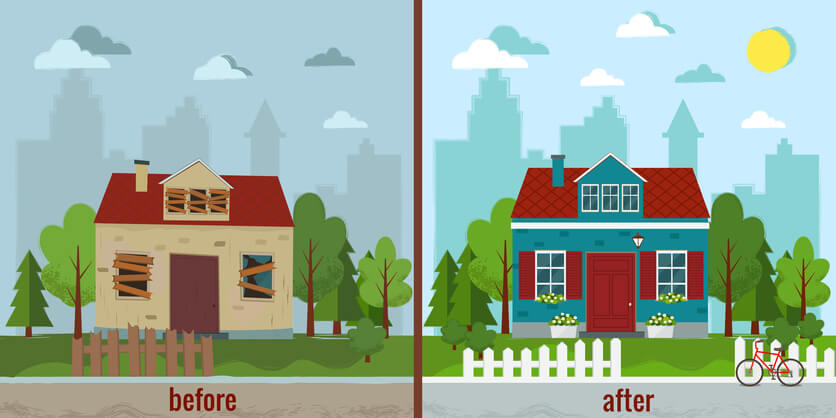
Before and After Photos Communicate What Words Can’t
Customers are typically hesitant to give a new contractor a shot—this is their home we’re talking about, after all. But residential contractors don’t exactly have the best reputation, either. Right or wrong, many new customers will be skeptical of your skills until you’ve proven yourself. An outstanding photo portfolio is a quick way to defend your quality of service without saying anything at all.
Similarly, photos offer a common vocabulary with which customers and contractors can communicate. Homeowners don’t always know the technical jargon associated with each job, but they can point out what they like in pictures. Providing snapshots of your past work helps clients in the idea phase as they try to envision what their space will look like once various features are remodeled.

Photos Give Your Web Presence Digital Cache
Photos aren’t just helpful from a service perspective, though. They’re also a smart move for your digital marketing and contractor lead generation strategy. Photos add professional polish to your website, particularly when they’re used smartly to illustrate the various services you offer.
Photos add punch to your web presence simply because they communicate information faster than words. The majority of your website visitors will spend less than 15 seconds on your site, so it’s important to make the most of that time. The brain processes images 600,000 times faster than text, allowing you to make the most of those few seconds you have.
Then there’s the issue of SEO and search engine ranking. Digital marketing experts argue back and forth about how photos impact your search engine score. Regardless, photos provide yet another avenue for customers to discover you: through Google image search. Additionally, all photos on your site can repurposed as posts on your social media accounts, with links back to your website. Adding those potential sources of traffic and linkbacks usually raises your site’s overall ranking and visibility in web searches.

Tips for Successful Photos
Of course, you can’t do all that without great photos to begin with. Taking project photos can be tricky work, particularly if you’re not used to handling a camera. Luckily, these days, with high-quality smart phones and great free editing tools, you don’t really need any special equipment—just some photographer’s chops. Here are a couple of quick-and-dirty tips for snapping stunning before and after photos.
- Choose Projects With Great Visuals. No matter how thrilled that customer was with the shag carpeting you installed, it’s probably not a great candidate for a before and after photoshoot. Choose jobs with visual impact—ones that feature stylish finishes, unique colors or unusual project specifications.
- “Stage” the Shots. Let’s be honest here: not every contractor does the kind of work that would be featured on HGTV. But whether you’re shooting a new roof or hot water heater installation, the effect will be stronger if you take the time to clear debris and other eyesores away before taking after photos.
- Before and After Photos Should Feature Similar Angles for Maximum Contrast. Think back to those before and after weightloss photos you see in commercials. The person in the photos is always wearing the same kind of clothes, with the same mugshot stance. Try to match the angle and perspective in both photos. Take note of where you were standing when you took the first photo so you can match that composition later on.
- Take “Action” Photos of the Process. Homeowners like to see how the sausage gets made, and “action” shots provide a window into that process. It’s also a great chance to feature your crew and subcontractors on your website, too!
- Use Natural Lighting Where Possible. True, a finished basement may not have a lot of natural light, but where possible try to include some ambient lighting to get you the best photos possible.
- Use a Photo Editor to Place Before and After Photos Side-by-Side. Modern photo editing tools are wonderful. Use them to crop out distracting details, add attractive color filters and to arrange photos side-by-side for maximum impact.
- Hire a Professional Photographer. Nobody knows better than you do about the importance of hiring a pro. If you just can’t seem to master before and after photos, a professional photographer may be a better alternative. Photographers can compose and edit photos so that they have the polish you’re looking for. And who knows, maybe they have a friend who needs some repair work done on their home!
It takes a little practice, but after a while, you’ll be snapping photos like a bonafide Instagram star. Hello, high-paying customers!