Solar is booming across the country — and it’s not slowing down. The U.S. solar industry installed 43 gigawatts (GW) of new capacity in 2025, marking the fifth straight year that solar led all energy sources for new capacity added to the grid, according to the Solar Energy Industries Association (SEIA) and Wood Mackenzie. That’s a significant milestone — and it shows no signs of stopping.
But not every state has the same story. Some have been building solar infrastructure for decades. Others have exploded onto the scene just in the past few years. Either way, solar panels consistently add value to your home — a 2025 SolarReviews analysis of Zillow data found that solar homes sell for about 6.9% more than comparable non-solar homes.
One important thing to know heading into 2026: the 30% federal residential solar tax credit (Section 25D) expired on December 31, 2025. It was repealed as part of the One Big Beautiful Bill Act signed in July 2025. If you installed solar before that date, you can still claim the credit on your 2025 tax return. But for new installations in 2026, the federal residential incentive is gone — which makes state-level incentives more important than ever.
Below, we’ve rounded up the top states for solar in 2026 — based on current SEIA data — along with what homeowners in each state should know right now.
California Solar Installations
Ranking
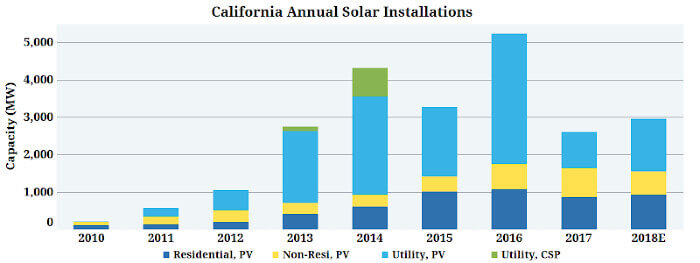
California still leads the nation in total installed solar capacity. SEIA reports the state has more than 55,000 megawatts (MW) of installed capacity — enough to power over 16 million homes. Texas has been closing the gap fast (more on that below), but California remains #1 in cumulative solar.
What homeowners should know
The federal residential tax credit is gone, but California still has strong state programs. The Self-Generation Incentive Program (SGIP) offers rebates for battery storage paired with solar, which is especially useful during peak-demand periods or grid outages. Net metering in California has shifted to the Net Billing Tariff (NEM 3.0), which changed how homeowners are credited for excess energy — so it’s worth talking to a local installer about how that affects your payback timeline. You can browse available state programs at DSIRE, the national database for renewable energy incentives.
Related: California Guide to Residential Solar Energy
Good to know
California also launched “Project Nexus” in 2025, an initiative that installs solar panels over water canals. The dual benefit: clean energy generation and reduced water loss from evaporation. It’s an example of how California continues to find creative ways to scale solar beyond rooftops.
Texas Solar Installations
Ranking
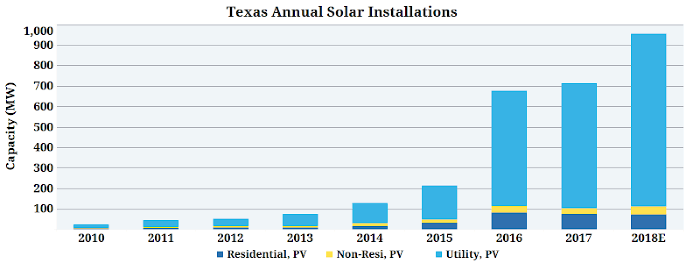
Texas is now the country’s fastest-growing solar market — by a wide margin. SEIA reports that Texas installed 11 GW of new solar capacity in 2025 alone, more than any other state. Its total installed capacity now sits around 53,500 MW, just behind California. If that pace holds, Texas could claim the #1 spot within a few years.
What homeowners should know
Texas doesn’t have a state income tax, which means some of the traditional state solar incentive structures look different here. But there’s still plenty working in your favor. Property tax exemptions apply to the added value solar panels bring to your home, and many utilities offer rebates. The state also passed legislation in 2025 that strengthens consumer protections for residential solar buyers — worth knowing if you’re starting the process. Browse state-specific programs at DSIRE.
Related: Texas Guide to Residential Solar Energy
Good to know
Texas’s solar growth isn’t just residential. Utility-scale solar farms are booming, fueled by rising electricity demand from data centers and industrial development. SEIA describes Texas as the “Energy Capital” of solar — a title it’s earning fast. And solar’s growth here benefits rural landowners too, who can lease land for solar development and earn supplemental income.
Florida Solar Installations
Ranking
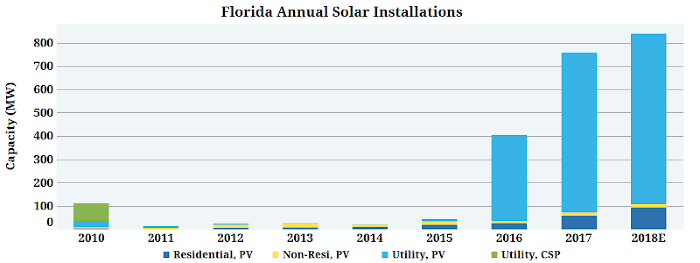
Florida has solidified its place as one of the top three solar states in the country. SEIA reports the state has over 18,500 MW of installed solar capacity — enough to power more than 2.2 million homes. Florida was also among the top five states for new installations in Q1 2026, according to SEIA’s Q2 2026 Market Insight report.
What homeowners should know
Florida has a property tax exemption for residential solar, meaning the added home value from your panels won’t increase your property tax bill. Net metering is also available through most Florida utilities. After Hurricanes Helene and Milton in 2024, some communities that had solar — and battery storage — were able to keep their lights on when the grid went down. That resilience factor is becoming a real selling point for Florida homeowners. Find current state incentives at DSIRE.
Related: Florida Guide to Residential Solar Energy
Good to know
The “Sunshine State” nickname finally matches its energy output. Florida’s solar sector has transformed over the past decade from a laggard into a national leader — driven by falling installation costs, utility interest in large-scale solar, and growing homeowner demand for energy independence.
Arizona Solar Installations
Ranking
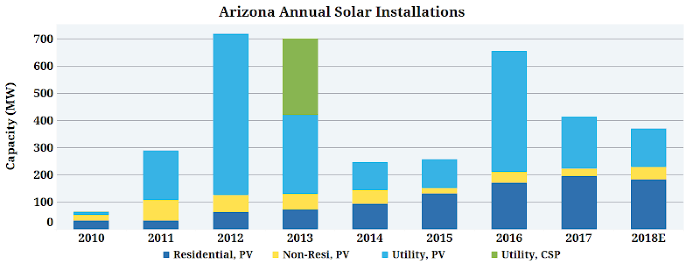
Arizona ranks fourth in the nation for total installed solar capacity, with enough solar to power roughly 1.45 million homes, according to SEIA. The state also ranked among the top 10 for new capacity added in 2025 — driven by both residential and utility-scale growth.
What homeowners should know
Arizona offers some of the most homeowner-friendly solar policies in the country. There’s a state income tax credit worth 25% of installation costs (up to $1,000), plus a sales tax exemption on solar equipment and a property tax exemption on the added home value. Favorable net metering rules have also helped make Arizona one of the faster-growing residential solar markets in the U.S. Check the full list of available programs at DSIRE.
Related: Arizona Guide to Residential Solar Energy
Good to know
Arizona averages more than 300 sunny days per year, which translates to serious solar output. Homeowners who own their panels (rather than lease them) have been exempt from personal property taxes on that equipment since 2006 — a policy that predates most state solar programs in the country.
North Carolina Solar Installations
Ranking
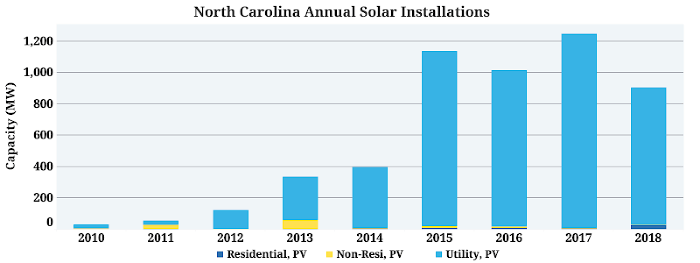
North Carolina is a consistent top-five state for solar, driven largely by utility-scale projects. SEIA ranks the state fifth nationally for total installed capacity — a remarkable position for a southeastern state that didn’t register nationally just 15 years ago.
What homeowners should know
North Carolina doesn’t have a state solar tax credit right now (a previous credit expired), but the state does offer a property tax exemption for solar installations and net metering is available through most utilities. Utility-scale solar has led the state’s growth, but residential interest is growing too — especially as electricity rates rise. You can find current incentive programs at DSIRE.
Related: North Carolina Guide to Residential Solar Energy
Good to know
North Carolina’s solar success is mostly a utility-scale story — massive solar farms that feed directly into the grid. That’s different from states like California or New Jersey, where residential rooftop solar has been the main driver. If you’re a homeowner in North Carolina, the policy environment is less aggressive than in some other top states, but the economics still work, especially if your utility offers good net metering terms.
Nevada Solar Installations
Ranking
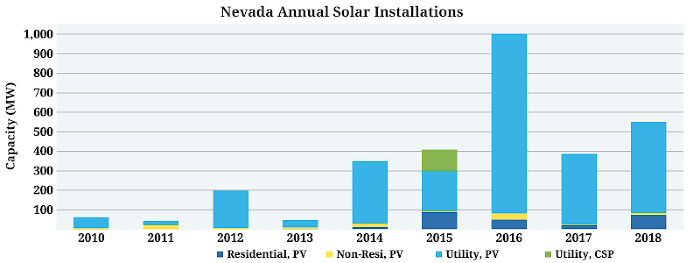
Nevada ranks in the top 10 nationally for total installed solar capacity, with solar accounting for a significant share of the state’s electricity mix. SEIA also ranked Nevada among the states with strong projected growth over the next five years.
What homeowners should know
Nevada offers a property tax abatement for solar installations and a sales tax exemption on solar equipment — both help lower your upfront costs. Net metering is available, though the state has adjusted its net metering policies a few times over the years; it’s worth confirming current rates with your utility before committing. Find all current programs at DSIRE.
Related: Nevada Guide to Residential Solar Energy
Good to know
Nevada gets more sun than almost any other state, which means solar panels here produce more energy per watt of installed capacity than in most of the country. That physical advantage — combined with a desert climate — makes Nevada a natural fit for both rooftop and utility-scale solar development.
New Jersey Solar Installations
Ranking
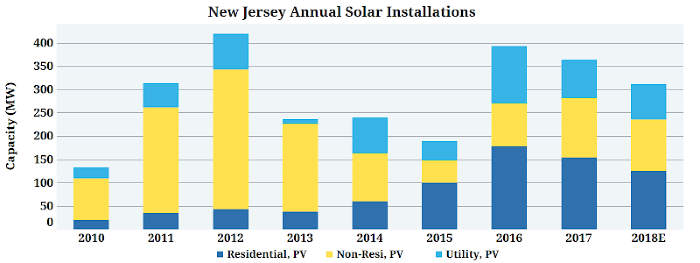
New Jersey punches well above its weight in solar. Despite being one of the smallest states by area, it consistently ranks in the national top 10 for installed capacity and has one of the most active residential solar markets in the country. SEIA’s 2025 Year in Review noted that New Jersey’s community solar installations grew 31% year over year.
What homeowners should know
New Jersey has one of the best state-level incentive stacks in the country — especially now that the federal residential tax credit has expired. The Successor Solar Incentive (SuSI) program pays homeowners quarterly for energy their system produces over 15 years. That’s a meaningful income stream on top of your energy savings. Net metering is also available. For a full list of current programs, visit DSIRE.
Related: New Jersey Guide to Residential Solar Energy
Good to know
Zillow research has found that New Jersey homeowners see some of the largest home value boosts from solar of any market in the country — nearly a 10% increase, or more than $32,000 on a median-priced home. If you’re planning to sell in the next several years, that’s a real financial argument for going solar now.
Massachusetts Solar Installations
Ranking
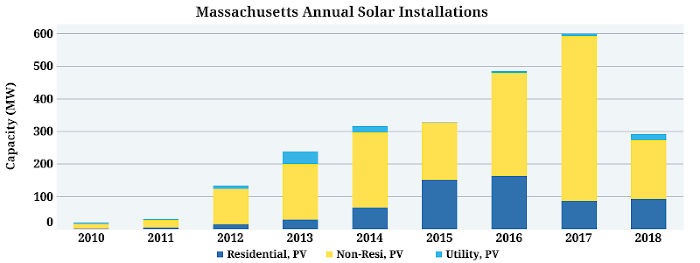
Massachusetts consistently ranks in the top 10 states for solar, with solar supplying a meaningful share of the state’s electricity. The state leads the country in community solar — SEIA’s 2025 Year in Review named New York as the top community solar market, but Massachusetts and New Jersey are close behind in program activity and subscriber growth.
What homeowners should know
Massachusetts has a strong set of state incentives. The Solar Massachusetts Renewable Target (SMART) program pays homeowners a fixed rate per kilowatt-hour their system produces for 10 years — similar to New Jersey’s SuSI. There’s also a state tax credit worth 15% of installation costs (up to $1,000) and a sales tax exemption on solar equipment. For the full list, check DSIRE. Community solar is also an option if your roof isn’t ideal — you can subscribe to a local solar project and get credits on your utility bill without installing anything.
Related: Massachusetts Guide to Residential Solar Energy
Good to know
Massachusetts isn’t the sunniest state, but that doesn’t matter as much as people think. Solar panels work on diffuse light, not just direct sunlight — and between the state’s strong incentive stack and high electricity rates, the return on investment here is competitive with sunnier markets further south.
New York Solar Installations
Ranking
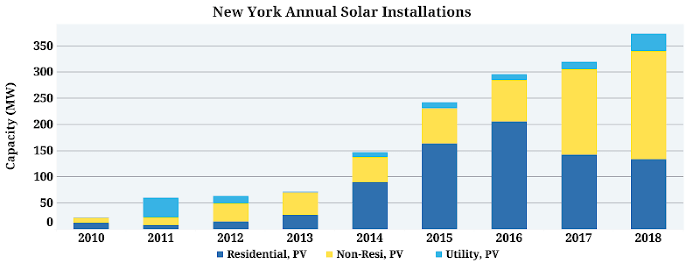
New York ranks in the top 10 nationally for total installed solar capacity, and it leads the entire country in community solar. SEIA’s 2025 Year in Review found that New York installed more community solar than any other state — though growth slowed about 20% year over year as the pipeline of legacy projects works through the system.
What homeowners should know
New York’s NY-Sun initiative continues to drive residential solar adoption with incentives funded through the New York State Energy Research and Development Authority (NYSERDA). There’s also a 25% state tax credit (up to $5,000) for residential solar — one of the more generous state credits in the country. Net metering is available, and community solar is a strong option if you rent or have a shaded roof. Find current programs at DSIRE.
Related: New York Guide to Residential Solar Energy
Good to know
New York homeowners see some of the biggest solar-driven home value premiums in the country. The Zillow research that found homes with solar sell for 4.1% more nationally found New York City homeowners could see a premium of around 5.4% — which adds up to roughly $24,000 on a median-priced home. That number is even higher in more recent analyses.
Utah Solar Installations
Ranking
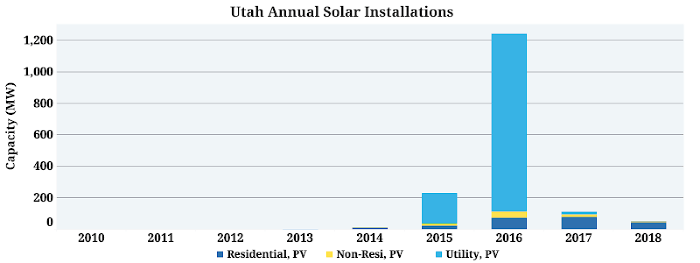
Utah has been one of the fastest-moving solar states in the country. SEIA’s 2025 Year in Review ranked Utah among the top 10 states for new capacity added, and deployment in the state has been surging — driven by both utility-scale farms and residential growth.
What homeowners should know
Utah offers a state tax credit worth 25% of solar installation costs (up to $1,600) — a meaningful offset now that the federal credit has expired. There’s also a property tax exemption on the added home value from solar, and net metering is available through major utilities. Check current programs at DSIRE.
Related: Utah Guide to Residential Solar Energy
Good to know
Salt Lake City’s solar capacity more than quadrupled between 2013 and 2018 — and it’s only accelerated since. Utah’s combination of high elevation, dry climate, and abundant sun makes it one of the most productive solar environments in the country. The state’s growth has caught a lot of the industry off guard, and it keeps climbing the national rankings.
Not sure which incentives apply to your home? A local solar installer can walk you through exactly what’s available in your state and utility district — including any utility rebates that aren’t listed in statewide databases.
Find the Right Contractor for Your Solar Project
Whether you’re ready to begin your project now or need some expert advice, our network of contractors are here to help. With a few simple questions, we’ll find the best local professionals for you