Leaf Home Ultraviolet (UV) Water Filter System Review 2026
Average Cost: $500 to $1,500
Key Features
- Chemical-free disinfection using ultraviolet light
- Neutralizes bacteria, viruses, and other pathogens
- Low-maintenance design that integrates with existing systems

The Modernize Mission
Modernize maintains homeowner-first editorial integrity, meaning we accept no commissions and no partner links for this review. Our reviews are thoroughly fact-checked by our home improvement experts. Ratings are determined by a sophisticated algorithm to rate brands, including analyses of products, materials, quality, costs, sizes, durability, energy efficiency, and warranties.
Table of Contents
- Leaf Home UV Water Purification System Review: Is It Worth It?
- How Does the Leaf Home UV Water Purification System Work?
- Who Should Use the Leaf Home UV System?
- What the Leaf Home UV System Does and Doesn't Treat
- Benefits and Drawbacks of the Leaf Home UV System
- How Much Does the Leaf Home UV System Cost?
- Leaf Home UV System Warranty: What It Actually Covers
- What Do Customers Say About the Leaf Home UV System?
- Is the Leaf Home UV Water Purification System Worth It?
- Frequently Asked Questions About the Leaf Home UV System
Leaf Home UV Water Purification System Review: Is It Worth It?
The Leaf Home UV Water Purification System uses UV-C light to kill bacteria, viruses, and protozoa in your home’s water supply, all without adding chemicals or changing the taste. UV disinfection is a proven technology, approved by both the EPA and NSF International for treating drinking water. Leaf Home offers this system for whole-home use, with professional installation and optional yearly maintenance.
Before you read on, it’s important to know that UV purification only deals with biological contamination. It does not remove chemical contaminants, heavy metals, nitrates, or dissolved solids. If your well water has both biological and chemical issues, you’ll need UV purification along with other filters, not just UV. This review explains how the system works, what it costs, what the warranty covers, and who should consider it.
Want to know what’s in your water? Start with a free Leaf Home water test.
How Does the Leaf Home UV Water Purification System Work?
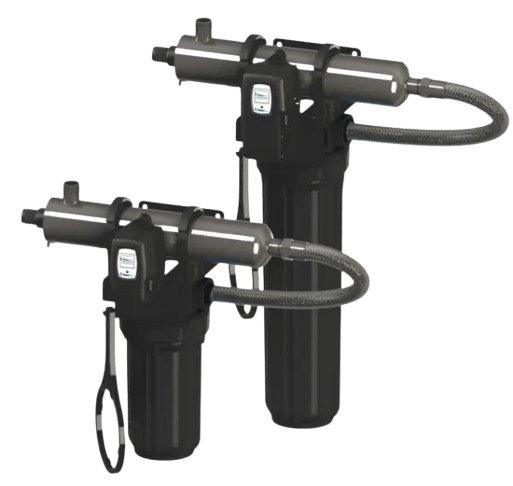
The system has a UV-C lamp inside a stainless-steel chamber. As water flows through, the UV-C light breaks down the DNA of microorganisms, so bacteria, viruses, and protozoa can’t reproduce or make you sick. This process doesn’t add chemicals and doesn’t change the taste or smell of your water.
A built-in 5-micron sediment pre-filter is placed before the UV chamber to catch particles that might protect microorganisms from the UV light. Clear water is important for the UV system to work well, since cloudy or dirty water blocks the light from reaching germs. This is why pre-filtration comes standard with the system.
Where and how is the UV system installed?
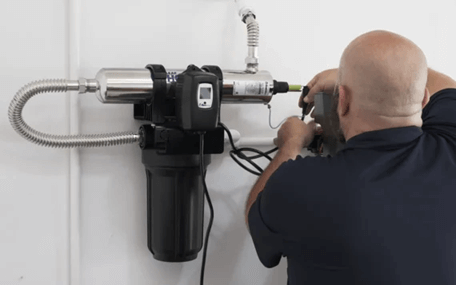
Leaf Home installs the UV system after your main filters, like sediment or carbon filters, so the water is clear when it reaches the UV light. Placement is important because installing it before filtration makes it less effective. Leaf Home’s technicians handle the installation to make sure everything is set up correctly, including the flow rate, placement, and electrical connection.
Flow rate is especially important. If water moves too quickly through the UV chamber, it doesn’t spend enough time under the lamp, and some germs might not be treated. One tip from a reviewer: the system needs an electrical outlet nearby. Make sure you have one before installation. At least one homeowner said their system didn’t work at first because there was no outlet.
Who Should Use the Leaf Home UV System?
The Leaf Home UV system is a good choice for homeowners worried about biological contamination, especially those with private wells or city water users who want extra protection from chlorine-resistant organisms. It’s not the best option if your main concerns are chemicals, heavy metals, or dissolved solids.
People with private wells have the highest risk of biological contamination. Well water isn’t treated by the city, so it can pick up bacteria, viruses, and protozoa from the ground, farm runoff, or nearby septic systems. The CDC says well owners should test for biological contamination at least once a year. If you find bacteria, a UV system can help fix the problem.
City water users who want extra protection from chlorine-resistant organisms like Cryptosporidium and Giardia can also benefit from UV as a second layer of treatment. City water treatment helps control these protozoa, but doesn’t always get rid of them completely. UV-C is one of the best ways to inactivate them.
UV purification isn’t the right solution if your main water concerns are chemicals like lead, arsenic, nitrates, fluoride, or industrial runoff. These need other treatments, such as reverse osmosis, activated carbon filters, or ion exchange. Leaf Home offers a free in-home water test to find out what contaminants you have before you decide on a system.
What the Leaf Home UV System Does and Doesn’t Treat
| Contaminant type | Examples | UV system effective? |
|---|---|---|
| Bacteria | E. coli, coliform, salmonella | Yes |
| Viruses | Hepatitis A, norovirus | Yes |
| Protozoa | Cryptosporidium, Giardia | Yes |
| Sediment and particles | Dirt, rust, sand | Pre-filter only (5 micron) |
| Chemical contaminants | Pesticides, herbicides, VOCs | No |
| Heavy metals | Lead, arsenic, mercury | No |
| Dissolved minerals | Nitrates, fluoride, chlorine | No |
Benefits and Drawbacks of the Leaf Home UV System
Pros
- Eliminates biological threats: Destroys bacteria, viruses, and protozoa, including chlorine-resistant Cryptosporidium and Giardia
- Chemical-free disinfection: No taste change, no byproducts added to water
- Whole-home protection: Covers every faucet and fixture in your home
- Low annual upkeep: Only the lamp and pre-filter need yearly attention
- Proven technology: EPA- and NSF-approved for drinking water disinfection
- Expert installation: Trained technicians ensure correct flow rate and placement
Cons
- Biological threats only: Won’t remove chemical contaminants, heavy metals, nitrates, or dissolved solids
- Lamp not covered by warranty: Replacement billed at prevailing rates from day one
- Short labor warranty: Labor covered for one year only; parts covered for three
- Non-transferable warranty: Coverage ends when you sell your home
- Outlet required: Confirm an electrical outlet is available before installation day
- High-pressure sales: Multiple verified reviewers describe the consultation as aggressive
How Much Does the Leaf Home UV System Cost?
The Leaf Home UV Water Purification System typically costs $500–$1,500 depending on model and configuration. Professional installation adds $300–$700, bringing the total installed cost to roughly $800–$2,200.
Yearly maintenance costs depend on how you replace the lamp. If you buy lamps yourself (make sure they’re compatible with Leaf Home), they usually cost $30–$80. If you use Leaf Home’s service, one reviewer said it costs $325 per visit. Before you sign a service agreement, check the yearly cost, contract length, and if you can buy lamps on your own.
Installation and ongoing costs
- Professional setup: Installed after existing filters; correct placement and flow rate are critical to effectiveness.
- Annual lamp replacement: The UV lamp’s output drops after about 9,000 hours of use, which is around one year, even if the lamp still looks lit. Replace it every year to keep the system working well.
- Pre-filter replacement: Replace the 5-micron sediment filter annually, or more frequently in high-sediment conditions.
- Service agreements: Optional annual servicing plans are available; read the full contract term, annual cost, and cancellation terms before signing.
Leaf Home UV System Warranty: What It Actually Covers
The Leaf Home Water Solutions (LHWS) warranty has several parts, and the details are important, especially since the component that needs the most maintenance is not covered.
UV system hardware warranty: 3 years
The UV system hardware — the stainless-steel reactor, ballast, and controller — carries a three-year warranty against defects in materials and workmanship from the date of original installation. That’s the only coverage available on UV system hardware components.
Labor warranty: 1 year only
LHWS covers labor to repair or replace a defective product for one year after installation. After that, any service call is billed at the current rate, even if the part is still under its three-year warranty. So, if a hardware problem comes up in year two or three, the part is covered, but you pay for the labor.
The UV lamp is not covered by warranty
This is the most important warranty detail to understand. The LHWS warranty explicitly excludes “bulbs, sleeves, sensors, cartridges, filters, elements, lamps or any wear part” and notes that both parts and labor for these items are billed at prevailing rates. The UV lamp — the component that needs annual replacement to maintain disinfection effectiveness — carries zero warranty coverage from day one.
This explains the $325 service charge mentioned in Trustpilot reviews. The warranty makes it clear that homeowners pay for lamp replacement. If you want lamp replacement included, that’s a separate service agreement, not part of the warranty.
The UV lamp is the part that kills bacteria and viruses, but it isn’t covered by the warranty. Before you buy, check how much it costs to replace the lamp each year and whether you can buy compatible lamps yourself or only through LHWS service calls.
The warranty is not transferable
The LHWS warranty is only for the original buyer and only while they live in the home. It doesn’t transfer to new owners, renters, or anyone else. If you sell your home, the warranty ends. Some competitors do let warranties transfer, so this is a real limitation.
Key warranty exclusions
- Non-certified installation voids coverage: The warranty is void if anyone other than a certified LHWS installer installs the product.
- Acts of God and environmental damage not covered: Fire, flood, freezing, lightning, and similar events are excluded.
- Oxidizing agents excluded: Damage from chlorine, ozone, or chloramines in the water supply is not covered — relevant for homes on city water with high chlorine levels.
- Non-potable water disclaimer: LHWS assumes no liability for products used with non-potable water sources or for determining the correct equipment for your water conditions.
- Post-year-one labor costs apply: After the one-year labor warranty expires, LHWS charges a service fee even for parts still within their warranty period.
What to confirm before signing: Ask for the full LHWS warranty document in writing before installation. Confirm the annual cost of UV lamp replacement and whether you can source lamps independently. If a service agreement is offered, get the full contract term, annual cost, and cancellation terms in writing before the installer leaves.
What Do Customers Say About the Leaf Home UV System?
Most reviews for Leaf Home Water Solutions are positive about the installation, water quality improvements, and the in-home water test. The main complaints, mentioned in several Trustpilot reviews, are about high-pressure sales tactics and service agreement costs that weren’t clearly explained before signing.
Positive experiences
“Our in-home assessment confirmed we had chemicals in our water despite having an existing water conditioner. The UV whole-house system with a new catalytic carbon system was exactly what we needed. The team arranged for immediate install on the same afternoon. Results: remarkable improvement!” — Larry Booth, Trustpilot
“[The representative] was very particular in testing our water to make sure we were getting the safest water possible. We are very pleased with the system — it has improved the quality of our water.” — Linda Mills, Trustpilot
“I have a well and live in a flood zone. The addition of the in-line UV light gives me the ability to drink and use clean water right from the tap.” — William G., Trustpilot
Negative and mixed experiences
“The sales people and the installer were very professional and friendly. My only complaint is I wasn’t told that we needed an electrical outlet for the UV disinfection system. The UV system is not working because I’m waiting for the power line to be connected.” — Hal, Trustpilot
“They’re charging $325 per year just to replace a UV light bulb under a 10-year contract. This service agreement was buried in the contract and never properly explained during installation. The UV light has a unique part number, making it impossible to find affordable alternatives.” — Nick Behnken, Trustpilot
“The water system really made a difference in our water taste and quality. The only negative thing is when the salesman arrived — the pressure is absolutely ridiculous and unpleasant.” — Wagner Ferreira, Trustpilot
Issues worth considering
Three issues from the reviews deserve direct attention before you purchase.
- Service agreement terms: Nick Behnken’s experience of paying $325 per year for UV lamp replacement under a 10-year contract with special parts matches what the LHWS warranty says. The warranty clearly excludes lamps and charges for parts and labor at current rates. This isn’t deceptive, but the terms should be explained up front. Ask for the full agreement in writing before installation, and check the yearly cost, contract length, and if you can buy lamps yourself.
- Electrical outlet requirement: Hal’s problem could have been avoided. Before installation day, check with your Leaf Home representative to see if you need an electrical outlet near where the system will go, and make sure you have one.
- Sales pressure: Several reviewers say the sales consultation felt high-pressure. Most people were happy with the product, but not with the sales process. Remember, the free in-home water test is also a sales meeting, so be ready for that.
Is the Leaf Home UV Water Purification System Worth It?
For homeowners with private wells and confirmed or suspected biological contamination, the answer is yes, the Leaf Home UV system is worth it. UV purification is one of the most effective and low-maintenance ways to keep your water safe, and Leaf Home’s professional installation and support make it a practical choice for your whole home.
If you’re also worried about chemical contaminants, heavy metals, or dissolved solids, UV alone won’t be enough. Start with the free in-home water test to find out what’s in your water before choosing a system. The results will show if UV is right for you or if you need extra filtration.
Have clear expectations about two things: the UV lamp isn’t covered by the warranty and will cost money to replace each year, and the sales consultation is usually high-pressure. Knowing these things before you meet with a representative will help you be better prepared.
Ready to find out what’s in your water?