Bathroom Remodel
How Much Do Quartz Bathroom Countertops Cost?
Average Cost: $500 – $2,000
Quartz bathroom countertops offer durability and a polished look, and most vanity tops cost $500 to $2,000 installed. That works out to $50 to $120 per square foot, including materials and installation. Vanity size, quartz grade, edge style, and sink cutouts drive the final price. Premium slabs and large double vanities can cost more.
Find the best bathroom remodel pros in your area.

The Modernize Mission
We help homeowners make confident decisions through our reliable, up-to-date, and unbiased information and average project costs. All of our content is thoroughly reviewed and fact-checked by our team of home improvement experts. Learn more about how we maintain these values.
Table of Contents
- How Much Do Quartz Countertops Cost in a Bathroom?
- Quartz Countertop Cost by Grade
- Premium vs. Standard Quartz Countertops
- Quartz Countertop Color Options
- Benefits and Drawbacks of Quartz Bathroom Countertops
- What Impacts Quartz Countertop Cost the Most?
- How Tariffs and Silica Rules Affect Quartz in 2026
- Quartz vs. Other Countertop Materials
- Are Quartz Countertops Worth the Investment?
- Are Quartz Bathroom Countertops Right for Me?
- Quartz Countertop Cost Calculator and Planning Tools
- Frequently Asked Questions
- Next Steps for Your Quartz Countertop Project
- Sources
How Much Do Quartz Countertops Cost in a Bathroom?
Most homeowners pay $500 to $2,000 to have quartz installed on a bathroom vanity. A standard 60-inch double vanity top averages about $1,000. Quartz typically costs $50 to $120 per square foot installed, and most bathroom vanity tops measure only 5 to 15 square feet. Large vanities, premium slabs, and custom details can push the total past $3,000.
Standard colors and simple vanity layouts tend to cost less, while marble-look designs, thicker slabs, and custom cutouts cost more. Quartz usually costs more than laminate and entry-level solid surface countertops. In return, you get a durable, low-maintenance finish that many homeowners prefer in bathrooms.
- Average Project Cost: About $1,000 (60-inch double vanity)
- Typical Installed Range: $500 to $2,000
- Cost Per Square Foot Installed: $50 to $120
- Best For: Homeowners who want a low-maintenance, durable, upscale vanity top
| Item | Typical Cost | Notes |
|---|---|---|
| Standard quartz (installed) | $50 to $70 per square foot | Common colors and simple patterns |
| Mid-grade quartz (installed) | $70 to $100 per square foot | Wider range of colors and finishes |
| Premium quartz (installed) | $100 to $150 per square foot | Designer looks, dramatic veining; top lines can reach $200 |
| Labor (included in installed price) | $10 to $30 per square foot | Templating, cutouts, setting, finishing |
| Typical edge upgrade | $8 to $20 per linear foot | Varies by profile |
| Sink cutout | $100 to $250 per cutout | Varies by sink type |
How much does quartz countertop cost per square foot?
Quartz countertops cost $50 to $120 per square foot installed for most projects. Premium and designer slabs can reach $150 to $200 per square foot. Labor makes up about $10 to $30 of that price, depending on the layout, number of sink cutouts, edge style, and local fabrication rates.
Quartz countertop cost at a glance
| Cost Category | Typical Price Range |
|---|---|
| Installed Cost (Typical) | $50 to $120 per square foot |
| Standard Quartz | $50 to $70 per square foot |
| Mid-Grade Quartz | $70 to $100 per square foot |
| Premium Quartz | $100 to $150+ per square foot |
| Labor | $10 to $30 per square foot |
| Typical Bathroom Vanity Top | $500 to $2,000 total |
Quartz countertop cost by vanity size
Your vanity size sets the square footage, so it’s the quickest way to estimate your total. These ranges include fabrication and installation.
| Vanity Top | Approximate Size | Typical Installed Cost |
|---|---|---|
| Single vanity | About 6 square feet | $400 to $700 |
| 48-inch vanity | About 8 square feet | $550 to $1,300 |
| 60-inch double vanity | About 9 square feet | $700 to $1,400 |
| 72-inch double vanity | About 11 square feet | $850 to $1,700 |
Labor cost
Professional installation adds about $10 to $30 per square foot. Labor covers templating, fabrication, delivery, sink and faucet cutouts, setting the slab, and final finishing. Complex vanity layouts, thicker slabs, specialty edges, and unusual seam placement can raise labor costs for your bathroom countertop project.
Typical project total
For most bathrooms, the installed total lands between $500 and $2,000. Double vanities with premium colors, full-height backsplashes, and custom edges can push costs past $3,000. If you’re also replacing the vanity cabinet, budget for that separately. A new bathroom sink can also change your cutout costs.
Quartz Countertop Cost by Grade
Quartz pricing is easiest to understand when you group it by quality tier. These installed prices help you compare design expectations against your budget.
- Budget Quartz: $50 to $70 per square foot installed. These collections (from brands like MSI and LG Viatera) usually offer simpler colors and patterns.
- Mid-Grade Quartz: $70 to $100 per square foot installed. Brands like Silestone and Caesarstone sit here, with a wider range of colors and finishes.
- Premium or Luxury Quartz: $100 to $150+ per square foot installed. Brands like Cambria and designer collections often feature bold veining and marble-inspired looks.
Premium vs. Standard Quartz Countertops
Premium quartz delivers designer colors, dramatic veining, and stronger brand recognition, often at $100 to $150 per square foot installed or more. Standard quartz focuses on core colors and simpler patterns at about $50 to $70 per square foot installed. On a 9-square-foot vanity top, that’s about $450 to $630 for standard quartz and $900 to $1,350 for premium.
Quartz Countertop Color Options
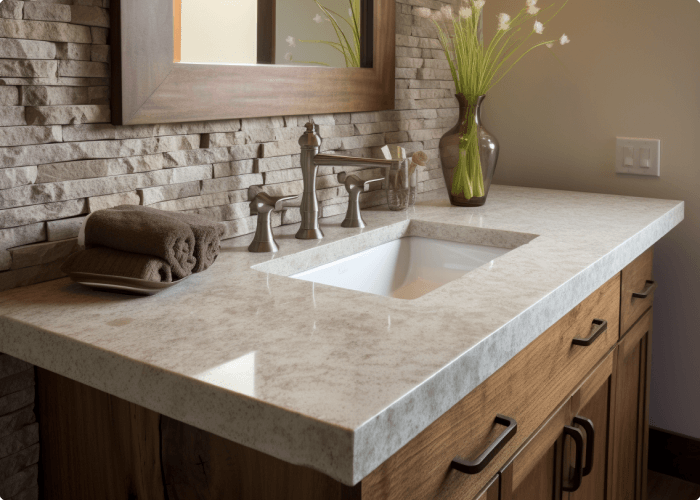
Quartz comes in a wide range of colors and patterns, so it’s one of the most flexible bathroom countertop materials for design-conscious homeowners. Marble-look veining usually costs more than solid colors.

- Classic Whites: Clean and timeless, from bright white to subtle marble-look veining.
- Earthy Tones: Beige, taupe, gray, and greige pair well with wood vanities and matte hardware.
- Bold and Dark Shades: Charcoal, black, and deep blue add contrast and a more dramatic look.
- Pastel Hues: Soft greens, blues, and blush tones can create a spa-like atmosphere.
- Patterned Quartz: Marbled, speckled, and swirled finishes add movement and visual texture.
Benefits and Drawbacks of Quartz Bathroom Countertops
Quartz suits most bathrooms, but it has trade-offs. Weigh both sides before you buy.
Benefits
- Durability: Quartz is hard, scratch resistant, and built for daily use.
- Low Maintenance: The non-porous surface resists stains and does not need sealing.
- Moisture Resistance: Splashes and humidity won’t harm it the way they can harm some materials.
- Design Versatility: You can choose from a wide variety of colors and patterns.
Drawbacks
- Heat Sensitivity: Hot styling tools can scorch the resin, so use a heat-safe mat.
- Higher Upfront Cost: Quartz costs more than laminate and some solid surface options.
- Supply and Safety Questions: New tariffs and silica rules may affect price and availability.
What Impacts Quartz Countertop Cost the Most?
Quartz countertop prices vary based on a few key factors. If you’re comparing quotes, watch these details most closely.
- Brand: Top-tier brands like Cambria, Caesarstone, and Silestone usually cost more than builder-grade options.
- Color and Pattern: Simple colors are typically cheaper than bold, marble-look veining or premium finishes.
- Thickness: Thicker slabs can cost more and may change fabrication requirements.
- Fabrication Complexity: Edge profiles, sink cutouts, backsplash pieces, and seam placement all affect labor cost.
- Vanity Size: Larger vanities and double-sink layouts require more material and fabrication time.
- Slab Origin: Imported slabs now carry a federal tariff that fabricators may pass on to you.
How Tariffs and Silica Rules Affect Quartz in 2026
Two developments this year can change what you pay and what you can buy. Both are worth a question to your fabricator before you sign.
New federal tariff on imported quartz
On July 31, 2026, the president signed a four-year safeguard measure on imported quartz surface products. It took effect August 15, 2026. Imports within a yearly quota pay an added 25% duty, and anything above the quota pays 50%. The rates step down over four years. Slabs and finished items such as vanity tops are covered, while products from Canada, Mexico, and a long list of other countries are exempt. Natural granite is not part of this measure.
No one can predict your exact price, but fabricators who use imported slabs may raise quotes or shorten how long they honor them. Ask where your slab is made and how long the quote is valid. Our guide to how tariffs affect renovation costs explains the broader picture.
Silica safety rules for fabricators
Engineered quartz contains crystalline silica. The documented health risk comes from silica dust created when slabs are cut, ground, and polished, which affects fabrication workers most. California requires shops to suppress dust with water, and in September 2026 state regulators released a draft rule that would prohibit fabrication of engineered stone with more than 1% crystalline silica. That rule is not final as of this writing. Australia banned engineered stone in 2024.
Ask your fabricator how they control dust, and check the current rules if you live in California. Laminate and solid surface countertops don’t use engineered quartz.
Quartz vs. Other Countertop Materials
Quartz is commonly compared with granite, marble, laminate, and solid surface countertops. These materials can look similar, but they differ in maintenance, durability, cost, and performance.
| Material | Installed Cost Per Square Foot | Sealing Needed? |
|---|---|---|
| Quartz | $50 to $120 | No |
| Granite | $45 to $100 | Yes, periodically |
| Marble | $80 to $200 | Yes, regularly |
| Solid surface | $45 to $95 | No |
| Laminate | $10 to $25 | No |
- Quartz vs. Granite: Quartz offers consistent color and requires no sealing, making it easier to maintain. Granite is a natural stone with unique veining and variation, handles heat better, and requires periodic sealing.
- Quartz vs. Marble: Quartz is more durable and resistant to stains, scratches, and moisture. Marble delivers a high-end, natural look with dramatic veining, but it is more porous, prone to etching, and requires regular maintenance.
- Quartz vs. Laminate: Laminate is the most budget-friendly option but is less durable and more prone to damage. Quartz costs more upfront but offers a longer lifespan and a more premium appearance.
- Quartz vs. Solid Surface: Solid surface countertops are often cheaper and repairable, but they are softer and less heat- and scratch-resistant than quartz. Quartz is harder and better suited for long-term durability.
Quick Take: Choose quartz for low maintenance and durability, marble for natural luxury, granite for unique stone variation, laminate for budget projects, and solid surface for repairability.
Are Quartz Countertops Worth the Investment?
For many homeowners, yes. Quartz delivers a polished look, strong durability, and easy upkeep in a room that sees regular moisture and daily use. A vanity top is a small part of your budget, so the upgrade from laminate often adds several hundred dollars. Resale matters too: a mid-range bathroom remodel recoups about 80% of its cost at sale, according to Zonda’s 2025 Cost vs. Value Report. See our breakdown of the bathroom remodel cost vs. value to plan how far to go.

Are Quartz Bathroom Countertops Right for Me?
Consider quartz if you want a durable, low-maintenance bathroom surface with a wide range of design options. It’s especially appealing for primary bathrooms where you want an upscale look without the sealing that some natural stone requires. If you often use hot styling tools on the counter, plan for a heat-safe mat or choose granite.
Prep checklist before quartz countertop installation
- Confirm final vanity placement, wall angles, and clearances.
- Choose your edge profile, backsplash height, and faucet hole layout.
- Pick the sink type and number of cutouts.
- Decide on thickness, often 2 cm or 3 cm, and any seam locations.
- Ask where the slab is made, how long your quote is valid, and how the shop controls silica dust.
- Protect the path for delivery and cover nearby floors and cabinets.
- Have fixtures on site for the template appointment.
Quartz Countertop Cost Calculator and Planning Tools
If you’re still narrowing down your budget, compare prices by square footage, material tier, and bathroom layout before you request quotes. A bathroom remodel cost calculator can estimate your project total based on your layout and finish preferences. Once you have quotes, evaluate them line by line so you can compare slab, edge, and cutout costs fairly.


Frequently Asked Questions
Next Steps for Your Quartz Countertop Project
Quartz brings a clean, modern look, reliable durability, and low maintenance to primary bathrooms. Start with your vanity size and layout, choose a color family you love, and compare a standard line against one premium option. Then confirm square footage, edge details, slab origin, and final pricing with a local fabricator. Before you hire anyone, use this bathroom remodeler hiring checklist to vet your options.
Sources
- Zonda, 2025 Cost vs. Value Report overview (Journal of Light Construction)
- Slabwise, bathroom countertop cost guide (July 2026)
- Angi, bathroom vanity installation cost (2026)
- Stone World, four-year tariff-rate quota on imported quartz surface products (August 2026)
- KPMG, safeguard tariff-rate quota on quartz surface products
- KQED, California regulators unveil plan to ban new quartz countertops (September 2026)