If you’re watching your utility bills climb and wondering whether solar is finally worth it, you’re not alone — and the off-season may be the smartest time to make your move. Most homeowners assume spring is the right time to kick off a solar project, but winter and fall installations come with real advantages: shorter contractor wait times, more competitive pricing, and a system that’s ready to produce at full capacity when summer heat drives electricity demand back up.
That timeline matters more than you might think. The process from finding a solar company and evaluating quotes to permitting, ordering equipment, and completing interconnection with your utility can take anywhere from six weeks to six months. Starting in winter means your panels could be live and generating power by the time your spring and summer bills arrive.
Don’t Worry About Cold Weather Affecting Your Panels
It’s one of the most common solar misconceptions: that winter weather hurts panel performance. The truth is more nuanced — and mostly reassuring. Solar panels generate electricity from light, not heat. In fact, cold temperatures can actually make panels work better.
Here’s why: photovoltaic (PV) cells become less efficient as they overheat. Once panel surface temperature exceeds roughly 77°F, efficiency starts to drop. On a crisp winter day, panels stay well below that threshold, which is why research consistently shows that cold-weather panels can operate 10%–12% more efficiently than on a sweltering summer afternoon, according to 8MSolar.
Cold panels are efficient panels. Solar cells rely on light, not warmth — your system will continue producing power through every season, even on overcast winter days.
What about snow?
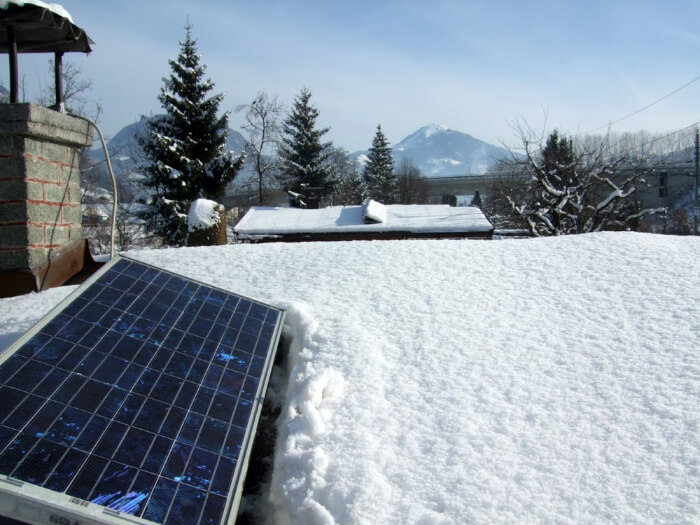
Snow does temporarily block panel output, but its impact is far smaller than most homeowners expect. A five-year study by the Northern Alberta Institute of Technology found that snow coverage causes only about 3% annual energy loss — well below older industry estimates of 20%, according to Solar Tech Online. Most panels are installed at a tilt that lets snow slide off naturally within hours of a storm. Heavy, wet snowfall can cover panels for a day or two, but that’s the exception, not the rule.
Cold-weather states have proven this out in practice. According to Sunrun, Massachusetts, New York, and New Jersey consistently rank among the top 12 states for solar installations — not despite their winters, but with full awareness of them. A good installer will design your system with your local climate in mind, including optimal panel tilt for snow shedding and equipment rated for your regional weather conditions.
Related: How Do Solar Panels Work?
Save Money with Seasonal Discounts and Off-Season Availability
Winter is the solar industry’s slow season — and that’s good news for your wallet. Installers have fewer jobs on their calendar, which means you’re more likely to get a faster quote, more contractor attention, and a better deal. According to Solar Tech Online, homeowners who start their solar projects in fall or winter typically see 15%–25% cost savings and experience significantly shorter scheduling delays compared to peak-season shoppers.
During the summer, contractors are often booked weeks out and equipment suppliers face long lead times. In winter, the same installers have more flexibility, permitting offices are less backlogged, and equipment tends to ship faster. That combination of conditions is what turns a winter installation into a spring-ready system.
In our recent interviews, 47% of homeowners told Modernize they had taken advantage of timely promotions or savings offers to offset the costs of their solar installation. Seasonal discounts from contractors are one of the most reliable ways to capture that kind of savings — but they don’t last forever.
Understanding Solar Incentives in 2026
The incentive landscape for residential solar changed significantly at the start of 2026. Here’s what you need to know before getting quotes.
The federal residential tax credit has expired
The 30% Residential Clean Energy Credit (Section 25D) — the federal solar Investment Tax Credit (ITC) that had been available to homeowners since 2005 — expired on December 31, 2025. It was repealed early by the One Big Beautiful Bill Act (Public Law 119-21), signed in July 2025. Homeowners who install solar with cash or a loan in 2026 receive no federal tax credit on their personal return.
If you installed solar before December 31, 2025, you can still claim the 30% credit on your 2025 tax return via IRS Form 5695. But for new 2026 installations, the federal residential ITC is gone. Always consult a tax professional to confirm your specific eligibility.
One important exception: solar leases and power purchase agreements (PPAs) may still benefit from federal incentives. The commercial ITC (Section 48E) allows the system owner — not the homeowner — to claim the credit and pass the savings to you through lower monthly rates. Ask any installer offering lease or PPA financing how they reflect that benefit in your contract.
State and utility incentives still matter
The expiration of the federal credit doesn’t mean solar incentives are gone — it means state-level programs are now the primary lever for savings. These vary widely by location and include net metering credits, state tax credits, utility rebates, property tax exemptions, sales tax exemptions, and performance-based incentive programs.
The Database of State Incentives for Renewables & Efficiency (DSIRE) remains the most comprehensive public resource for finding what’s available in your state. Since programs change frequently and funding caps can close programs without warning, always verify current status with DSIRE or your installer before factoring any incentive into your financial projections.
States with some of the strongest remaining programs include New York (NY-Sun incentive), Massachusetts (SMART program, 25% state credit), New Jersey (SREC-II program), Arizona (25% state tax credit, capped at $1,000), and South Carolina (25% state tax credit, up to $35,000). Net metering — which credits you for excess solar power you send back to the grid — remains in place in most states, though California’s NEM 3.0 policy has reduced export rates significantly for new installations, making battery storage increasingly important in that market.
Related: Solar Rebates and Incentives Guide
What Solar Costs in 2026— by State
National average residential solar installation costs in 2026 range from about $2.50 to $3.50 per watt before incentives, according to EnergySage. For a typical 7 kW home system, that translates to roughly $17,500–$24,500 upfront. Where you live has a meaningful impact on that number — and on how quickly your system pays for itself.
Installation costs are lowest in high-competition Sun Belt markets like Texas and Arizona, where strong solar irradiance and large installer networks drive prices down. Costs are highest in the Northeast, where labor rates are higher and permitting is more complex — but those same states often have the highest electricity rates, which means faster payback periods despite the steeper upfront cost.
Below are current cost ranges and key stats for 10 leading solar states. Pricing reflects 2026 market rates per watt for a professionally installed residential system before incentives. State incentive counts are sourced from DSIRE; installed home counts reflect the most recent available SEIA data.
California
Average cost: $2.80–$3.20 per watt (roughly $19,600–$22,400 for a 7 kW system)
- California leads the nation in cumulative residential solar capacity, according to SEIA.
- Compare quotes from local California solar energy contractors.
- Explore California solar rebates and incentives, including SGIP battery storage rebates and net metering under NEM 3.0.
- Note: NEM 3.0 significantly reduces export credits for new installations; battery storage is strongly recommended for new California solar projects.
North Carolina
Average cost: $2.60–$2.90 per watt (roughly $18,200–$20,300 for a 7 kW system)
- North Carolina ranks among the top solar states in the U.S. for installed capacity, per SEIA.
- Compare quotes from local North Carolina solar contractors.
- Check DSIRE for current North Carolina incentives, including Duke Energy and Dominion utility programs.
Arizona
Average cost: $2.30–$2.65 per watt (roughly $16,100–$18,550 for a 7 kW system)
- Arizona consistently ranks among the lowest-cost solar markets in the country, per SolarQuest AI.
- Compare quotes from local Arizona solar contractors.
- Arizona offers a 25% state tax credit (capped at $1,000) plus property and sales tax exemptions; check DSIRE for current Arizona incentives.
Nevada
Average cost: $2.40–$2.80 per watt (roughly $16,800–$19,600 for a 7 kW system)
- Nevada offers strong solar economics thanks to high sun exposure and competitive installer pricing, per SEIA.
- Compare quotes from local Nevada solar contractors.
- Check DSIRE for current Nevada incentives, including net metering and property tax exemptions.
Texas
Average cost: $2.35–$2.65 per watt (roughly $16,450–$18,550 for a 7 kW system)
- Texas is one of the most competitive solar markets in the country, with high installer volume driving some of the lowest prices nationally, per SEIA.
- Compare quotes from local Texas solar contractors.
- Texas incentives are primarily utility- and municipality-level; check DSIRE for Texas programs specific to your utility area.
New Jersey
Average cost: $2.80–$3.30 per watt (roughly $19,600–$23,100 for a 7 kW system)
- New Jersey offers some of the strongest solar economics in the country, with a robust SREC-II program and full retail net metering paying $0.22–$0.29 per kWh for exports, according to Joule IO.
- Compare quotes from local New Jersey solar contractors.
- Check DSIRE for current New Jersey incentives.
Massachusetts
Average cost: $3.00–$3.60 per watt (roughly $21,000–$25,200 for a 7 kW system)
- Massachusetts has some of the highest electricity rates in the country, which drives strong solar returns despite higher installation costs. The state’s SMART program provides long-term performance incentives, per SEIA.
- Compare quotes from local Massachusetts solar contractors.
- Massachusetts offers a 15% state tax credit (up to $1,000) plus the SMART incentive program; check DSIRE for current Massachusetts incentives.
Florida
Average cost: $2.40–$2.80 per watt (roughly $16,800–$19,600 for a 7 kW system)
- Florida is a top-five state for residential solar installations and offers property and sales tax exemptions on solar equipment, per SEIA.
- Compare quotes from local Florida solar contractors.
- Full retail net metering is currently available in Florida; check DSIRE for current Florida incentives.
Utah
Average cost: $2.50–$2.90 per watt (roughly $17,500–$20,300 for a 7 kW system)
- Utah has seen strong solar growth driven by high sun exposure and competitive installation prices, per SEIA.
- Compare quotes from local Utah solar contractors.
- Check DSIRE for current Utah incentives, including net metering and Rocky Mountain Power programs.
Georgia
Average cost: $2.50–$2.90 per watt (roughly $17,500–$20,300 for a 7 kW system)
- Georgia’s solar market has grown substantially in recent years, driven by Georgia Power incentive programs and falling installation costs, per SEIA.
- Compare quotes from local Georgia solar contractors.
- Check DSIRE for current Georgia incentives, including Georgia Power’s renewable energy programs.
The Best Time to Install Solar Panels
With the federal residential tax credit now expired, timing your installation no longer means racing a federal deadline. But that doesn’t mean timing doesn’t matter — it means the reasons to move sooner have shifted.
Electricity rates are rising. According to Home Contractors 101, national residential power prices are projected to climb 4.2% in 2026 alone, driven largely by surging energy demand from AI data centers and higher natural gas costs. Installing solar now means locking in your energy costs while utility rates continue to climb.
State and utility incentive programs are another reason not to wait. Programs like Massachusetts’ SMART incentive and New Jersey’s SREC-II program have funding caps; when they’re full, they close — sometimes with little notice. The homeowners who benefit most from solar are those who act before programs change, not after.
Whether you start your project in January or October, the long-term financial case for solar is strong. Getting quotes from multiple installers, understanding your state’s current incentives, and comparing system designs are the steps that make the biggest difference in what you’ll actually pay and save. The best season to install solar is the one when you’re ready — and winter makes that readiness a lot more rewarding.
Find the Right Contractor for Your Solar Project
Whether you’re ready to begin your project now or need some expert advice, our network of contractors are here to help. With a few simple questions, we’ll find the best local professionals for you