The Search Box Isn’t Dying – It’s Evolving Into Answer Engines
Your next customer won’t Google you—they’ll ask about you. AI assistants like ChatGPT, Google AI Overviews, and Microsoft Copilot are impactfully shaping customer journeys before any click happens. This shift has created a new, 100% organic marketing channel — and the brands that act first on adopting an Answer Engine Optimization (AEO) strategy will own the answer layer of the internet before it’s dominated by ads.
What Is Answer Engine Optimization (AEO)?
AEO helps your brand get cited and trusted inside AI-driven search experiences. Where traditional SEO fights to rank #1 in Google search listings, AEO focuses on being the answer within Large Language Models (LLMs).
Think of it this way: Traditional SEO builds the best storefront on a busy street; AEO makes sure every concierge recommends your store by name.
How AEO Works:
Brand Mentions > Rank: AI assistants value citation frequency and consensus across trusted domains more than traditional keyword ranking.
Long-Tail Discovery: LLMs thrive on multi-step, conversational questions—opening new organic entry points for brands that answer comprehensively.
Influence Builds Trust: Repeated citations across credible third-party sources pre-qualify users before they ever visit your site, shaping buying intent earlier in the journey.
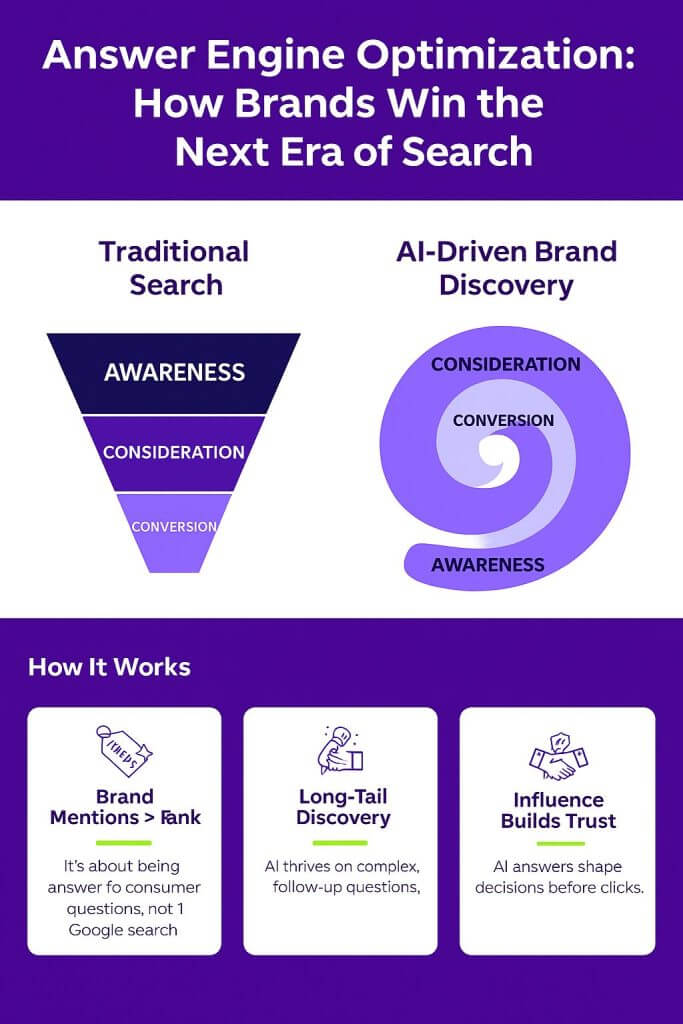
AEO vs. Traditional SEO
While SEO and AEO share the goal of visibility, they optimize for different ecosystems and different signals.
| Traditional SEO | Answer Engine Optimization (AEO) |
|---|---|
| Competes for rank on search-engine results pages (SERPs). | Competes for relevance in AI-generated answers. |
| Builds domain authority through backlinks and on-page optimization. | Builds mention density and structured clarity across the web. |
| Results appear after months of optimization and indexing. | Citations can appear in days once AI models ingest corroborated data. |
| Focuses on traffic-first metrics like CTR and impressions. | Focuses on trust-first metrics—citations, sentiment, and brand consistency. |
Why Now? Adoption, Visibility and First-Mover Advantage
AI search usage is exploding with over 7.7B users per month across platform as of 2025. All signals indicate this is the new big organic search channel and early adoption is critical.
Recent research on ChatGPT user intent shows users increasingly skip navigation in favor of direct outcomes. In addition, users exposed to AI-generated brand citations were nine times more likely to convert than those interacting with standard SERP results.
Meanwhile, Google’s own updates confirm that AI Overviews now appear in over 40% of searches — signaling a permanent change in how consumers discover information.
For early adopters, the benefits of adopting an AEO strategy now are significant:
- First-mover advantage that compounds through habitual citations.
- Faster visibility than traditional SEO.
- Higher-intent journeys as assistants answer complex follow-ups.
The Data Speaks: Benchmarks & Independent Studies
Modernize’s June 2025 internal benchmarking study across 100 home service brands found that appearing in AI Overviews or top-10 organic results 53% of the time correlated with 3 to 4x higher on-page conversion rates.
These findings echo Ahrefs’ correlation analysis, which identified brand mentions as the strongest factor (r = 0.664) tied to inclusion in AI Overviews.
The takeaway? Brand presence beats brand rank.
What Signals Matter Most in AEO
Answer engines don’t rank pages — they synthesize trust. That means their algorithms evaluate patterns of accuracy, authority, and corroboration across the entire web.
Instead of relying solely on backlinks or keyword density, AI systems like ChatGPT, Perplexity, and Google AI Overviews use a concept called “consensus validation.” They look for multiple, independent signals confirming the same facts — and they reward brands whose information appears consistent, structured, and verifiable across sources.
In practical terms, the more your brand’s information is repeated, reviewed, and referenced across credible ecosystems, the more likely it is to be surfaced in an AI-generated response. These signals collectively shape your brand’s “citation fingerprint” — a measurable imprint of how LLMs perceive your reliability and relevance.
Here’s what those signals look like in action:
- User Reviews (UGC): Real user experiences posted to Google Business Profiles, Trustpilot, or niche directories tell AI systems your brand is active and trusted by real people. Frequent, detailed reviews also help models understand sentiment — a key signal of credibility.
- Expert Reviews: Articles, industry comparisons, or case studies authored by recognized professionals lend topical authority. AI models tend to cite expert commentary when summarizing brand reputations.
- Visual Evidence: Photos and videos act as “proof points.” When consistently labeled and embedded across web properties, they validate that your business is authentic, operational, and transparent — qualities LLMs increasingly factor into answer selection.
- Forum & Q&A Activity: Presence on open forums like Reddit, YouTube, and industry-specific communities demonstrates community engagement and trust-building transparency. LLMs scan these unbranded sources heavily when forming recommendations and answer sets.
Building the Framework for a Successful AEO Strategy
Once you understand what Answer Engine Optimization is and why it matters, the next step is creating the foundational structure that makes your brand discoverable and trustworthy inside AI-driven search results.
Unlike traditional SEO, AEO isn’t about short-term ranking gains — it’s about building an ecosystem of credibility that large language models can recognize, reference, and repeat.
Here’s where to start:
Track Your Share of Voice (SoV)
Treat this as your new visibility metric. Instead of focusing on keyword rank, measure how often your brand appears in answers from ChatGPT, Copilot, Perplexity, or Google AI Overviews.
Build Fan-Out Query Maps
LLMs operate conversationally, not transactionally. That means users don’t stop at one question — they ask follow-ups.
To capture this behavior, create “fan-out” maps: identify 10 to 20 logical follow-up questions a user might ask after your primary topic. This structure gives AI systems depth and reinforces your topical authority across an entire question cluster — not just one keyword.
Invest in Third-Party Mentions
AI assistants reward cross-domain corroboration. That means your presence on trusted third-party sites (industry blogs, directories, review platforms, or forums) directly impacts whether you’re cited in AI-generated summaries. The goal is consistency — your brand facts, tone, and core messages should align everywhere your name appears.
Structure for Extraction
LLMs look for clarity, structure, and schema. Make it easy for them to cite you. Add Q&A formatting and structured data to your content so AI systems can pull accurate answers directly. This not only improves AI discoverability but also strengthens your Google AI Overview inclusion potential.
The Takeaway
Search isn’t disappearing — it’s transforming. We’re entering an age where search engines don’t just find answers; they create them. If your brand isn’t cited in those answers, it doesn’t exist in the modern discovery ecosystem. AEO is the next big organic marketing channel—and the window for first-mover advantage is right now. Those who lean in early will own visibility long after everyone else starts chasing it.
Learn more about Modernize’s Marketing Platform Services.