Insulation
R13 vs. R15 Insulation: Differences, Cost, Best Use
On this page
- What R13 and R15 mean for insulation
- Key differences between R13 and R15 insulation
- Best use cases for each insulation R-value
Find the best insulation pros in your area.

The Modernize Mission
We help homeowners make confident decisions through our reliable, up-to-date, and unbiased information and average project costs. All of our content is thoroughly reviewed and fact-checked by our team of home improvement experts. Learn more about how we maintain these values.
Table of Contents
- What Does R-Value Mean In Insulation?
- What Is R13 Insulation?
- What Is R15 Insulation?
- R13 vs. R15 Insulation: Key Differences
- Which Insulation Is Better for Exterior Walls?
- Cost Differences Between R13 vs. R15 Insulation
- Climate and Building Code Considerations
- Can You Upgrade from R13 to R15 Insulation?
- R13 vs. R15 Insulation: Which One Should You Choose?
- FAQs About R13 vs. R15 Insulation
What Does R-Value Mean In Insulation?
R-value measures how well insulation resists heat flow. Higher R-values do a better job slowing heat transfer, which can improve comfort and help reduce heating and cooling costs. R13 and R15 are two of the most common insulation levels. This guide explains when it’s best to use each type, average costs, and key differences.
What Is R13 Insulation?
R13 is a common insulation level for 2×4 walls, especially in older homes and moderate climates. In fiberglass batts, it’s typically sized to fit standard wall cavities and is often sold in 3.5-inch thickness for 2×4 framing.
Where Is R13 Insulation Commonly Installed?
R13 is frequently used in:
- Interior walls for sound reduction (when paired with good air sealing)
- Exterior 2×4 walls in milder climates or older code baselines
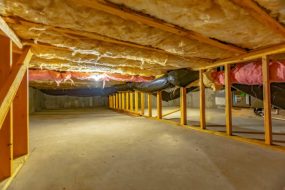
- Basement insulation or crawl spaces in limited-scope retrofit projects (when moisture is already addressed)
If you’re trying to hit today’s energy savings goals in colder regions, R13 alone may not be enough for exterior walls.
What Is R15 Insulation?
R15 is a step up from R13 and is often achieved in 2×4 walls using higher-density fiberglass batts. Many R15 batts are also 3.5 inches thick, meaning they can fit the same framing depth as R13 while delivering more insulating value.
Where Is R15 Insulation Commonly Installed?
R15 is commonly used in:
- Exterior 2×4 walls when homeowners want stronger performance without changing framing depth
- Energy-conscious remodels, especially in colder climates
- Rooms that feel drafty or run hot or cold compared to the rest of the house
R13 vs. R15 Insulation: Key Differences
| Feature | R13 | R15 |
|---|---|---|
| Typical 2×4 batt thickness | About 3.5 inches | About 3.5 inches (often high-density) |
| Heat-flow resistance | Good baseline | Better, especially for exterior comfort |
| Best use case | Interior walls, mild climates, budget-focused retrofits | Exterior 2×4 walls, comfort upgrades, colder climates |
| Code alignment trend | Often needs added continuous insulation in many zones | More likely to help meet cavity targets, but still may need continuous insulation depending on zone |
In plain terms: R15 is usually the “same fit, better performance” option in a 2×4 wall cavity, while R13 is the budget-friendly baseline that may still work well in interior applications.
Which Insulation Is Better for Exterior Walls?
For exterior walls, R15 is often the better pick if it fits your wall depth and budget because it improves comfort and helps reduce heat loss.
That said, many energy codes focus on a combination approach for 2×4 walls, such as “R-13 + R-5” (cavity insulation plus continuous insulation). That “+5” is typically rigid foam or another continuous layer that reduces thermal bridging through studs.
If your goal is a noticeable comfort upgrade in an exterior wall and you are already opening the wall, R15 is usually the stronger choice. If you are doing a minimal retrofit, R13 can still make sense with good air sealing.
Cost Differences Between R13 vs. R15 Insulation
R15 materials typically cost more than R13 because achieving a higher R-value in the same thickness usually requires higher-density insulation. R15 batting typically costs 10% to 30% more than R13 fiberglass batting, with more expensive options around 50% more. Our insulation installation cost guide breaks down what to expect by square foot.
Is R15 Insulation Worth the Extra Cost?
Often, yes, if it’s an exterior wall and you care about comfort. R15 can help reduce that “cold wall” feeling in winter and make rooms easier to keep stable. For interior walls, the value is usually lower, and you might get more benefit from air sealing and sound-focused materials.
If you’re getting quotes, you can find insulation contractors near you and compare pricing for your home.
Climate and Building Code Considerations
Climate matters because heat loss (and comfort problems) scale with temperature extremes.
A helpful way to think about it:
- Milder climates: R13 can be acceptable for some exterior-wall projects, especially when paired with strong air sealing.
- Mixed and colder climates: Exterior walls often benefit from higher cavity R-values and, in many cases, continuous insulation such as “R-13 + R-5.”
Separately, insulation manufacturers publish guidance that exterior wall recommendations commonly fall within ranges that include and exceed these values, depending on zone and assembly.
Can You Upgrade from R13 to R15 Insulation?
Yes, but it depends on access and wall depth.
Common upgrade scenarios:
- During a remodel: If drywall is coming down anyway, swapping R13 for R15 in exterior 2×4 cavities is straightforward.
- Targeted comfort fixes: One consistently cold room can be upgraded when walls are opened for electrical, plumbing, or window work.
- Not opening walls: If walls stay closed, upgrading from R13 to R15 is usually not practical. In that case, air sealing, rim-joist work, or adding continuous insulation during siding replacement can move the needle more.
R13 vs. R15 Insulation: Which One Should You Choose?
If it’s an exterior 2×4 wall, R15 is typically the better pick for comfort and performance, especially in mixed and cold climates. If it’s interior walls or you’re keeping things strictly budget-focused, R13 is often enough, and you can spend effort on air sealing and detailing.
A common decision homeowners choose:
- Choose R13 for interior walls, mild climates, and quick retrofits.
- Choose R15 for exterior walls, comfort upgrades, and energy-conscious remodels.
- If your area expects “R-13 + R-5” style assemblies, plan for continuous insulation too.
Modernize can connect you with the best insulation contractors in your area so you can get quotes and compare prices.