As a national leader in roofing, siding, windows, and bath remodeling, DaBella understands that growth is not just about increasing lead volume. It is about building systems that support scale. With more than 60 locations across the country and performance spread across 10s of thousands of ZIP codes, efficiency matters just as much as demand.
To better understand how leading contractors manage growth responsibly, we sat down with Josiah McMillan, Senior Demand Generation Manager at DaBella, to hear his side of what it has been like growing up with the company. Starting as a telemarketer in 2016 and now leading the growth and analytics teams, Josiah brings a data-driven approach to contractor lead generation and marketing performance.
This is the story of how DaBella has continued to scale even when adversity hits.
Growing with Data, Not Guesswork
DaBella began in the Pacific Northwest and has expanded across the country. Today, the company manages performance across thousands of ZIP codes and multiple service lines.
That kind of growth requires more than intuition.
As Josiah explains, the question is not just, “Are we getting enough leads?” The better questions are:
- Are we getting enough appointments to support our sales teams?
- Are we reaching homeowners quickly?
- Are we investing in the right markets?
- Are we maintaining healthy marketing costs?
In established markets, DaBella focuses on keeping its cost of marketing within target ranges. In newer markets, the focus shifts to volume. Sales teams need enough appointments to get reps in and to grow, even if it means missing a typical CoM(cost of marketing) tolerance.
For Josiah, growth and efficiency must work together. One cannot come at the expense of the other.
The Impact of Post Rejects, It’s a Science Experiment
In contractor lead generation, a post-reject happens when a lead is sent through a compliance and filtering system but is later rejected, often because it is considered a duplicate or does not meet certain criteria.
Last November, a configuration within DaBella’s lead filtering system temporarily impacted how some returning homeowner submissions were processed. Because Modernize closely monitors lead performance in real time, the team quickly identified the shift and collaborated with DaBella and their vendor to resolve the configuration.
Once the adjustment was made, DaBella saw performance stabilize and improve, reinforcing the value of the 30-day deduplication window(we recommend this) while maintaining access to high-intent homeowners throughout their decision process.
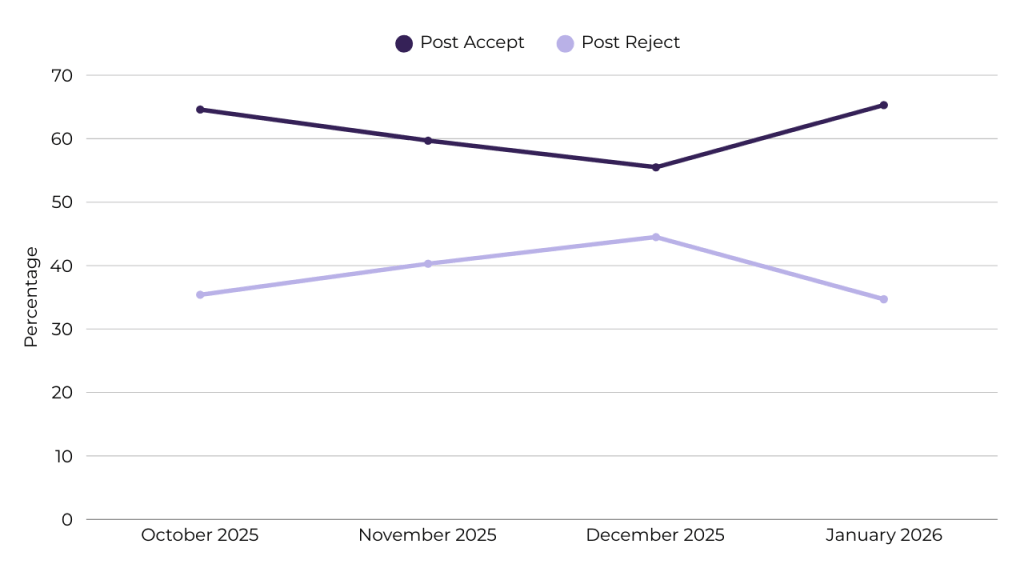
For Josiah, the experiment was about refining efficiency, not reducing opportunity. DaBella worked closely with Modernize to review performance, evaluate the data, and make adjustments. Transparency on both sides made it possible to respond quickly and protect long-term performance.
Moving from Time Windows to Lifetime Value
The real shift was bigger than adjusting a 30-day rule.
Josiah and his team are advanced and try to evaluate leads on more than just intent timing. There is a whole life-time value that each customer can fulfill, and how can they maximize that. Rather than concentrating on when a lead last came through, they started looking at whether there had ever been meaningful engagement with that homeowner and whether the inquiry reflected genuine intent.
Not all leads are treated the same. A homeowner who reaches out directly through DaBella’s website is handled differently than an event lead, and the same goes for each and every source. That level of segmentation allows the team to protect efficiency without bottlenecking growth.
What Home Improvement Marketing Teams Can Learn
Performance matters. But so does trust.
DaBella values partners who are transparent about:
- Lead sourcing
- Performance changes
- Adjustments being made
- Data visibility
Even when performance fluctuates, a partnership can remain strong if both sides communicate clearly and act on shared goals.
Trust allows teams to solve problems together instead of pointing fingers.
DaBella’s experience offers three important lessons for contractors investing in home improvement marketing.
- Post-reject spikes can signal optimization, not failure.
- New markets need volume to grow. Mature markets need efficiency.
- Strong partnerships require both data and transparency.
At Modernize Home Services, we are proud to work with contractors like DaBella who treat marketing as a long-term strategy built on trust, communication, and smart use of data.
Because sustainable growth does not happen by accident. It is built intentionally.
DaBella has partnered with Modernize for more than 10 years, building a relationship grounded in transparency, operational alignment, and measurable performance. In 2025 alone, DaBella saw a 32.7% year-over-year increase in net revenue and a 32.8% increase in issued appointments, generating $50 million in net revenue through our partnership.
We are proud to support DaBella’s continued growth and look forward to expanding our partnership as they enter new markets, launch new trades, and scale even further in the years ahead.