Leaf Home Reverse Osmosis System Review 2026
Average Cost: $1,500 to $3,000
Key Features
- Multi-stage filtration for ultra-pure drinking water
- High-capacity design for consistent daily use
- Reduces contaminants like lead, chlorine, and PFAS

The Modernize Mission
Modernize maintains homeowner-first editorial integrity, meaning we accept no commissions and no partner links for this review. Our reviews are thoroughly fact-checked by our home improvement experts. Ratings are determined by a sophisticated algorithm to rate brands, including analyses of products, materials, quality, costs, sizes, durability, energy efficiency, and warranties.
Table of Contents
- Leaf Home Reverse Osmosis System Review: Is It Worth the Investment?
- How Does the Leaf Home Reverse Osmosis System Work?
- Who Should Get a Leaf Home RO System?
- Benefits and Limitations of the Leaf Home RO System
- How Much Does the Leaf Home RO System Cost?
- Leaf Home RO System Warranty
- What to Know Before Your Leaf Home Consultation
- What Do Customers Say About the Leaf Home RO System?
- How Leaf Home RO Compares to Alternatives
- Is the Leaf Home RO System Worth It?
- FAQs About Leaf Home RO Systems
Leaf Home Reverse Osmosis System Review: Is It Worth the Investment?
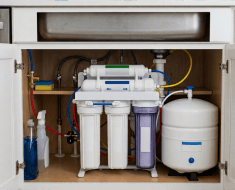
Leaf Home‘s Reverse Osmosis (RO) System filters out contaminants like chlorine, lead, fluoride, arsenic, and PFAS “forever chemicals” from your drinking water. It provides clean water through a special under-sink faucet or a refrigerator dispenser. The system uses several filtration stages (sediment, carbon, and an RO membrane) and is installed by a professional for everyday household use.
The installed price of $1,500–$3,000 is much higher than similar DIY under-sink RO systems. Whether the extra cost is worth it depends on whether you prefer professional installation and support, or saving money by handling filters yourself. Verified reviewers say the water tastes and looks better, but they also mention some issues, like slow water flow, tank refill time, and a pushy sales process. This review explains how the system works, long-term costs, warranty details, and how it compares to other options.
Want to know what’s in your drinking water? Start with a free Leaf Home water test.
How Does the Leaf Home Reverse Osmosis System Work?
Reverse osmosis pushes water through a special membrane that blocks dissolved contaminants but lets water molecules through. The Leaf Home system uses extra filters before the membrane to help it last longer and remove more types of contaminants.
The system can make up to 600 gallons of purified water each day and uses less wastewater than older RO systems. Traditional systems can waste two to four gallons for every gallon they purify. The clean water is kept in a pressurized tank under your sink and comes out when you use the special faucet or refrigerator line.
Before you buy, know that tank-based RO systems give water at a slower rate than a regular tap, and the tank needs about an hour to refill after heavy use. This is normal for these systems, not just for Leaf Home. Two verified reviewers below mentioned this wasn’t explained during their sales meetings.
- Sediment pre-filter: Removes particles, sand, and rust that would clog the RO membrane
- Carbon pre-filter: Reduces chlorine, chloramines, and volatile organic compounds (VOCs) before the membrane stage
- RO membrane: The primary filtration stage; removes dissolved solids, heavy metals, fluoride, arsenic, and PFAS
- Post-filter: Polishes the water for taste before it reaches the faucet
Who Should Get a Leaf Home RO System?
The Leaf Home RO system is a good choice for homes with known water contamination, especially if you have lead, PFAS, arsenic, or high chlorine, or if you spend $30–$60 a month on bottled water. If your main concern is hard water, you’ll need a water softener instead.
This system is most useful if your tap water has confirmed contaminants, like lead (often found in older homes), PFAS (common near factories or military bases), arsenic (sometimes in well water), or high chlorine that changes the taste. Leaf Home offers a free in-home water test to find out what’s in your water before you decide.
It’s also practical for families who spend $30–$60 a month on bottled water. At that rate, a $1,500–$3,000 system can pay for itself in two to eight years, and you won’t have plastic waste.
If your main water issue is hardness (minerals that cause scale and dry skin), this system isn’t the only solution; you’ll need a water softener. RO systems do remove hardness minerals, but they also take out good minerals like calcium and magnesium. If you’re worried about minerals, talk to your Leaf Home consultant about your water before deciding.
Important product characteristics to know before purchasing
Tank-based RO systems give water more slowly than a regular tap, and the tank takes about an hour to refill after heavy use. This is normal for these systems, not a flaw. Two verified reviewers said this wasn’t explained during their sales meetings. Be sure to ask your consultant about flow rate and refill time before you buy.
One reviewer who already had a ZeroWater countertop RO unit said it worked about the same as the $1,500 Leaf Home system. If slow flow or refill time would be a problem for you, ask your consultant about tankless RO options or compare with ZeroWater and similar countertop systems before deciding.
Benefits and Limitations of the Leaf Home RO System
Pros
- Broad contaminant removal: Eliminates lead, arsenic, PFAS, fluoride, and chlorine
- Water-efficient design: Reduced wastewater output vs. older RO systems
- Replaces bottled water: Typical household savings of $30–$60 per month
- Dedicated faucet or fridge connection: Convenient daily access at the point of use
- Professional installation: Ensures correct pressure, connections, and leak prevention
- Free water test included: Identifies contaminants before recommending a system
Cons
- Higher upfront cost: $1,500–$3,000 vs. $200–$500 for comparable DIY systems
- Slow flow rate and tank refill time: Standard for tank-based RO; ask before purchasing
- Removes beneficial minerals: Calcium and magnesium filtered out alongside contaminants
- Wear parts not covered: Filters and RO membrane excluded from warranty from day one
- Subcontracted installers: Not Leaf Home employees; quality varies by technician
- High-pressure sales process: Four-hour appointments reported by verified reviewers
- Financing risk: One reviewer had an unauthorized credit card opened in error
How Much Does the Leaf Home RO System Cost?
The Leaf Home RO System costs between $1,500 and $3,000, depending on the model and setup. Professional installation adds another $300 to $700, so the total installed price is about $1,800 to $3,700.
For comparison, similar under-sink RO systems from brands like APEC, iSpring, and Waterdrop cost $200–$500 if you install them yourself. The higher price for Leaf Home covers professional installation, service support, and the LHWS warranty, not a big difference in filtration technology. Whether it’s worth paying more depends on whether you want professional help or prefer to save money by handling filters yourself.
Installation and ongoing maintenance costs
- Professional installation: $300–$700 depending on plumbing complexity; required for warranty validity
- Filter replacement: Pre-filters every 6–12 months and the RO membrane every 2–3 years; annual cost estimated at $50–$200
- System servicing: Optional maintenance plans at $100–$300 per year
- Annual checkups: At least one verified reviewer says a yearly checkup is required. Check if this is included in your service agreement or if it’s billed separately.
Leaf Home RO System Warranty
Based on the Leaf Home Water Solutions limited warranty structure documented across its product line, the RO system hardware is warranted against defects in materials and workmanship from the date of original installation. Labor is covered for one year only; after year one, service calls are billed at prevailing rates. Filters, membranes, and all wear parts are explicitly excluded from warranty coverage and billed at prevailing rates for both parts and labor from day one.
The warranty is only for the original buyer and doesn’t transfer if you sell your home. It’s not valid if anyone except a certified LHWS installer sets up the system. As Jack Friend points out in his review below, installers and service staff are subcontractors, not Leaf Home employees, so the quality of installation and service can vary depending on the technician.
Ask for the full written LHWS warranty for the RO system before installation. Check which parts are covered, how long the labor warranty lasts, and if you can buy filters and membranes from other sources. Make sure the warranty terms match what LHWS usually offers; don’t just assume.
What to Know Before Your Leaf Home Consultation
Before your Leaf Home consultation, remember that the free water test is also a sales meeting. Appointments can last up to four hours and may include high-pressure sales tactics. You have the legal right to cancel any in-home purchase within three business days. Always read any financing paperwork carefully before you sign.
- Sales appointment length: At least one reviewer said their in-home appointment lasted four hours and included high-pressure tactics, making it hard to end the meeting. Plan your time and know you can leave whenever you want.
- Your right to cancel: Under the FTC’s Cooling-Off Rule, you have three business days to cancel any in-home sale over $25, regardless of what a salesperson tells you. The salesperson is legally required to inform you of this right and provide a cancellation form.
- Financing applications: Read any financing paperwork carefully before signing. One verified reviewer had an unauthorized credit card opened in their name due to a sales rep error. Confirm exactly what credit product you’re applying for (a loan, a line of credit, or a credit card) before signing anything.
- Ask about flow rate upfront: Two reviewers highlighted below said slow flow rate and tank refill time were not mentioned. Be sure to ask your consultant about these before your appointment ends.
- Get water test results in writing: One reviewer reports that water test results were shown during the meeting but never provided in written form. Request a written copy before the appointment ends.
What Do Customers Say About the Leaf Home RO System?
Reviews for Leaf Home Water Solutions’ RO system are mostly positive about water quality, professional installers, and helpful consultants. The main complaints, seen in several Trustpilot reviews, are about long and pushy sales meetings, not mentioning slow flow rate or tank refill time, and one serious mistake with financing.
Positive experiences
“Randy was our point of contact from start to finish — clear communication, a good deal, and thoughtful follow-up. The team installed a whole-home water filter plus an under-sink RO system quickly and professionally. The water tastes crisp and clean, pressure is steady, and overall quality is noticeably better.” — Michael Tyler, Trustpilot
“By Tuesday I could already feel and taste the difference. My shower left my skin feeling better — I didn’t itch as much once dry. And my coffee, wow, it actually tasted great. Best decision we’ve made in a long time.” — Norman Currence, Trustpilot
“We are nearly three years in and happy with our purchase. We love our RO, which has frankly made us water snobs.” — Verified Trustpilot Reviewer (3-year owner)
Negative and mixed experiences
“Salesmen never addressed the reduced slow flow as part of his sales pitch. He did not talk at all about the reduced flow rate. I may have thought twice about the purchase had I known. I already had a ZeroWater countertop unit — it is essentially an RO unit — but I didn’t have to pay $1,500 for it.” — Scott, Trustpilot
“Only a relatively small volume of water is produced before the tank needs to refill itself for about an hour, and the flow of water is quite slow. Installers and service staff are subcontractors versus sales reps — they are responsible to Leaf but not Leaf corporate paid staff.” — Jack Friend, Trustpilot
“The sales rep had me complete the wrong financing application, which resulted in a credit card being opened in my name — something I didn’t want and never authorized. Although Leaf claimed they canceled it, a week later the unwanted card arrived. I now have a permanent credit inquiry because of their mistake. They have a solid product, but their sales practices completely undermine trust.” — Jim Clark, Trustpilot
Issues to consider
There are four main issues from the reviews you should know about before buying.
- Slow flow rate and tank refill time: Tank-based RO systems give water more slowly than a regular tap and need about an hour to refill after heavy use. This is normal for these systems, not a flaw. Ask your consultant about flow rate and refill time before you buy.
- Subcontracted installation: Leaf Home installers and service staff are subcontractors, not company employees. The quality of installation and service can vary by technician. Ask for your installer’s name and contact information before your appointment, and check how warranty service calls work after installation.
- Sales process length and pressure: Many people report pushy sales tactics with Leaf Home. You don’t have to decide right away, and the FTC Cooling-Off Rule gives you three business days to cancel any in-home sale over $25.
- Financing applications: Always read financing paperwork carefully and make sure you know what kind of credit product you’re applying for. If something goes wrong, contact both the creditor and the credit bureaus right away.
How Leaf Home RO Compares to Alternatives
Under-sink RO systems are a proven technology with lots of competition. Here’s how the Leaf Home system stacks up on the most important points.
Leaf Home RO vs. DIY under-sink RO systems (APEC, iSpring, Waterdrop)
Brands like APEC, iSpring, and Waterdrop offer under-sink RO systems with comparable multi-stage filtration for $200–$500 in materials, with DIY installation and widely available third-party replacement filters at $30–$80 per set. The filtration technology isn’t meaningfully different from what Leaf Home offers.
The main trade-off is between doing it yourself and having professional support. If you’re comfortable with basic plumbing, installing a DIY system and finding filters is easy. If you want professional installation, one contact for service, and the LHWS warranty, the higher Leaf Home price makes sense. The extra $1,300–$3,200 covers that service and support.
Leaf Home RO vs. whole-home filtration
An under-sink RO system cleans water at just one spot, usually your kitchen faucet or fridge. It doesn’t treat water for showers, baths, or laundry. If you’re worried about whole-home water quality, like chlorine effects on skin and hair or hard water scale, you’ll need a whole-home filter or water softener. Leaf Home also offers UV systems and water softeners that you can combine with the RO system for a complete solution.

Is the Leaf Home RO System Worth It?
If your home has water quality problems like lead, PFAS, arsenic, or high chlorine, the Leaf Home RO system does a good job of cleaning your water. Owners who have used it for three years say they’re still happy with it, and reviews agree the product is high quality. If you spend $30–$60 a month on bottled water, the $1,800–$3,700 system can pay for itself in three to eight years.
The real question is whether the higher price for Leaf Home is worth it for you. If you want professional installation, one contact for service, and the LHWS warranty, it might be. But if you’re comfortable buying and changing filters yourself, a $200–$500 APEC or iSpring system gives you similar filtration for much less money and without the service contract.
Bottom line: Start with the free Leaf Home water test to find out what’s in your water and if an RO system is right for you. Ask about flow rate and tank refill time before your appointment ends. Read all financing paperwork carefully before signing. Get the full warranty details and check if you can buy filters elsewhere. And remember, you have three business days to cancel any in-home sale.