Stairlifts
Stairlifts for Narrow Stairs: What to Know Before You Buy
Many homeowners worry their stairs might be too narrow for a stairlift. Narrow staircases are actually quite common, especially in older houses, townhomes, and homes with steep basement or attic stairs. While narrow stairs can limit your options, they usually do not make a stairlift impossible. You just need to choose your model more carefully.
This guide explains what counts as a narrow staircase, which stairlift types and models work best in tight spaces, the minimum width requirements, and what to do if your stairs are even narrower than usual.
Connect with the best stairlift pros in your area.

The Modernize Mission
We help homeowners make confident decisions through our reliable, up-to-date, and unbiased information and average project costs. All of our content is thoroughly reviewed and fact-checked by our team of home improvement experts. Learn more about how we maintain these values.
Table of Contents
What Counts as a Narrow Staircase?
Most standard residential staircases in the U.S. are 36 inches wide, which is the minimum required by current building codes for new homes. Many older houses, especially those built before 1970, have staircases that are narrower, sometimes only 28 to 30 inches wide between the walls or balusters.
When it comes to stairlifts, the important measurement is the clear width of your staircase. This means the usable space between the wall on one side and any railing, baluster, or wall on the other. The stairlift rail, carriage, and folded chair all need to fit here while still leaving enough room for others to use the stairs safely.
A staircase is generally considered narrow for stairlift purposes when the clear width falls below 30 to 32 inches. Below 28 inches, options become very limited, and a professional assessment is essential before pursuing any specific product.
Minimum Width Requirements by Stairlift Type
Different types of stairlifts need different minimum widths. Knowing your staircase’s width helps you focus on the right kind of stairlift before you start looking at specific models.
Straight Stairlifts
Standard seated straight stairlifts usually need a minimum clear staircase width of 28 to 30 inches, though this can vary by model. The chair and rail together take up about 18 to 22 inches of space when folded. There also needs to be enough room left for others to pass safely. Most building codes require at least 20 inches of clear space next to a parked stairlift.
Slim-Rail Stairlifts
Slim-rail stairlift models are specifically engineered for narrow staircases and can fit in stairwells as narrow as 26 to 28 inches in some configurations. These models use a narrower rail profile and more compact chair design to minimize the footprint without significantly compromising comfort or safety for most users.
Standing Stairlifts
Standing stairlifts have a smaller overall footprint than seated models because the perch and platform take up less horizontal space than a full chair with armrests and footrest. If your staircase is too narrow for a standard seated stairlift but width is a concern, a standing model is worth discussing with your installer.
Curved Stairlifts
Curved stairlifts need about the same width as straight models, but their rails are more complex, which can change how much space is left at different points on the stairs. For narrow, curved staircases, it is especially important to have an in-home assessment before choosing a model.
Inclined Platform Stairlifts
Inclined platform stairlifts need much more space than seated models, usually at least 32 to 36 inches wide, so they usually will not work on narrow stairs. If you use a wheelchair and your staircase is narrow, a vertical platform lift or a home elevator is probably a better option.
Connect with local stairlift installers for recommendations and free quotes.
Which Stairlift Models Are Best for Narrow Stairs?
Several of the best stairlift companies make stairlifts for narrow staircases. The key things to check are the folded chair width, the distance from the rail to the wall, and how much space is left beside the parked stairlift. These measurements help you see if a stairlift will fit and if others can still use the stairs when the lift is parked.
Harmar SL600
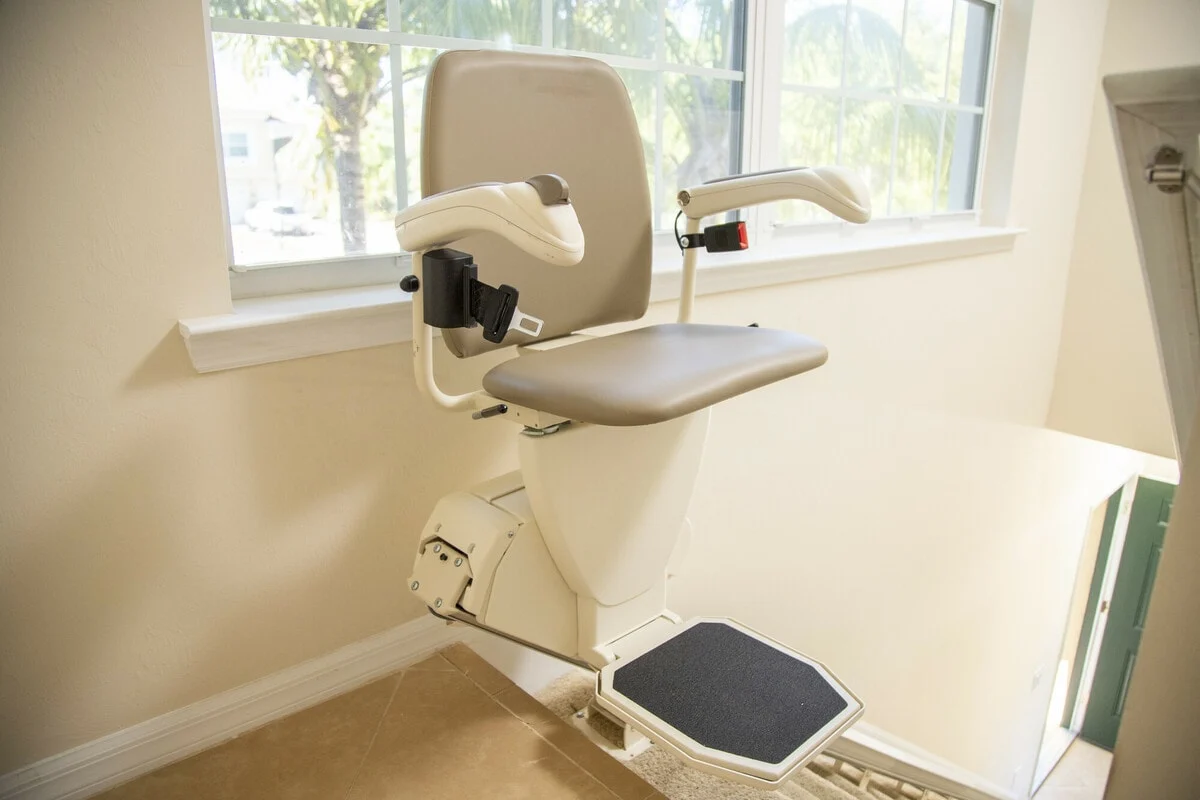
The Harmar SL600 has the narrowest folded profile of any standard seated stairlift on this list at just 10.5 inches. It also has a weight capacity of 350 pounds, making it a strong choice for narrow staircases where you do not want to give up load rating.
The rail mounts just 1 inch from the wall and stands 3 inches tall, so it stays out of the way when parked.
The SL600 uses a patented helical worm gear drive that does not need grease or lubrication, which is a real maintenance advantage for a stairlift that shares the stairs with others in your home.
- Folded width: 10.5 inches (13 inches with optional folding rail)
- Rail-to-wall distance: About 1 inch
- Weight capacity: 350 pounds
- Battery backup: Up to 60 trips
- Minimum staircase width: About 28 to 29 inches
- Best for: Homeowners with narrow straight staircases who want the slimmest seated footprint available without sacrificing weight capacity
Leaf Home Comfort Stairlift
Leaf Home’s Comfort model is built on the same Harmar SL600 platform, which means it shares that industry-leading 10.5-inch folded width.
What differentiates Leaf Home is the buying experience: the Comfort Lift is sold and installed exclusively through Leaf Home’s national network of factory-trained technicians, with a single point of contact for installation, service, and warranty claims.
Pricing requires an in-home consultation and is not published online.
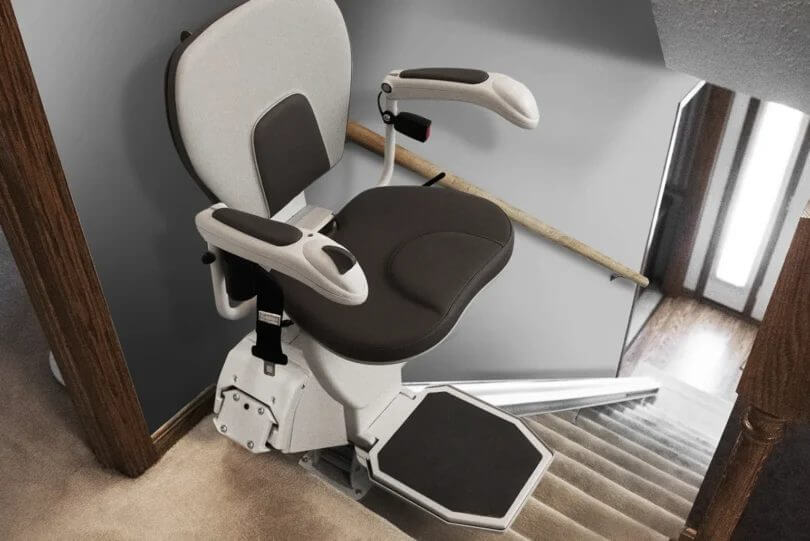
- Folded width: 10.5 inches
- Weight capacity: 350 pounds
- Battery backup: Up to 60 trips
- Minimum staircase width: 29 inches
- Best for: Homeowners who want a nationally recognized brand with end-to-end installation and service accountability under one warranty
Bruno Elan SRE-3050
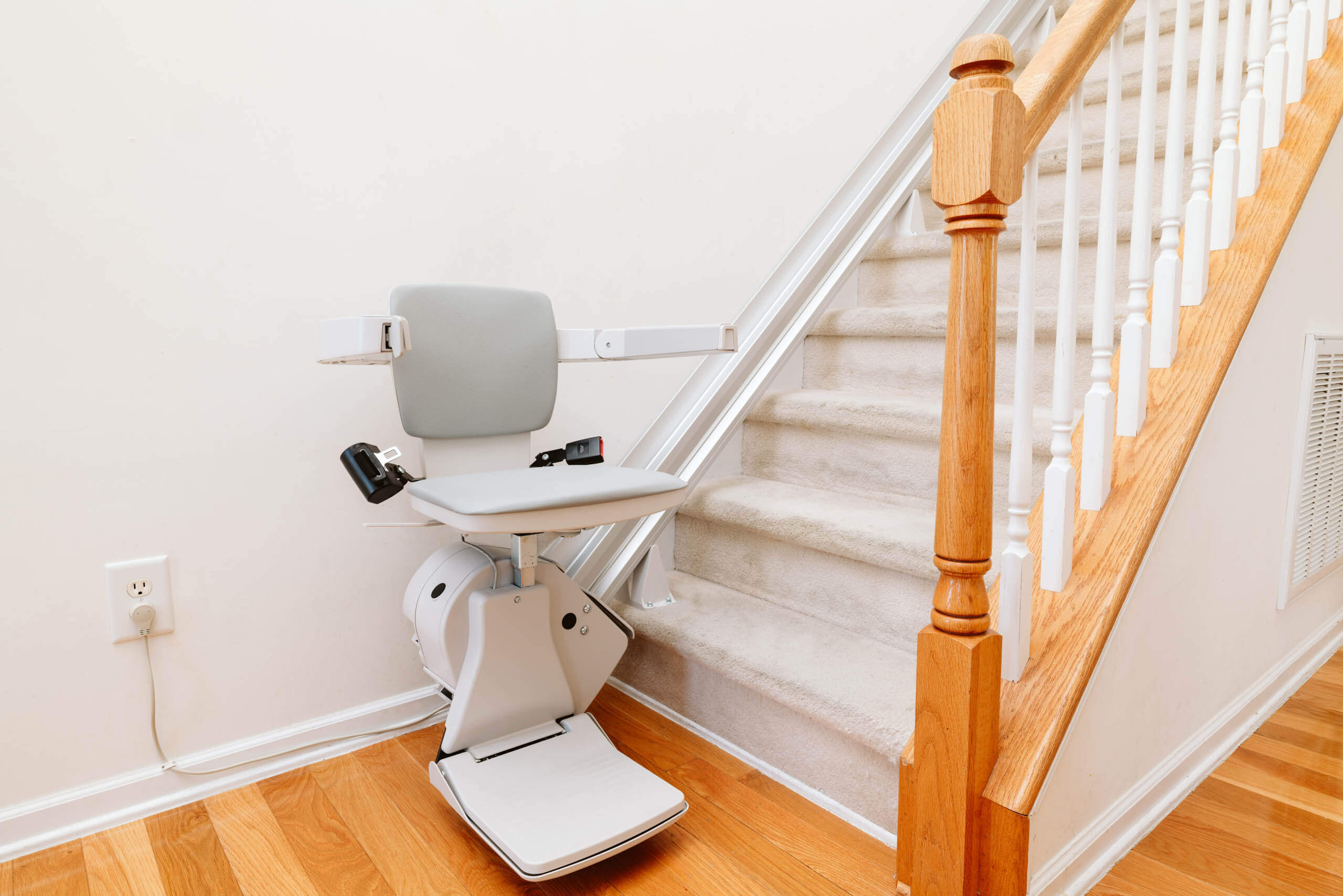
The Bruno Elan is a popular stairlift in the U.S. and works well for narrower staircases, though its folded width is a bit wider than the Harmar Pinnacle models.
When folded, the chair takes up 12 inches of space, and the rail can be installed just 5 inches from the wall, which is closer than most similar models. Its vertical rail design keeps the profile slim and leaves more room for others to use the stairs.
- Folded width: 12 inches
- Rail-to-wall distance: 5 inches (front of rail to wall)
- Seat width between armrests: 20.25 inches
- Weight capacity: 300 pounds
- Minimum staircase width: 28 inches
- Best for: Homeowners with moderately narrow staircases (28 to 32 inches) who want a widely available, American-made option with a strong dealer network
Harmar SL300
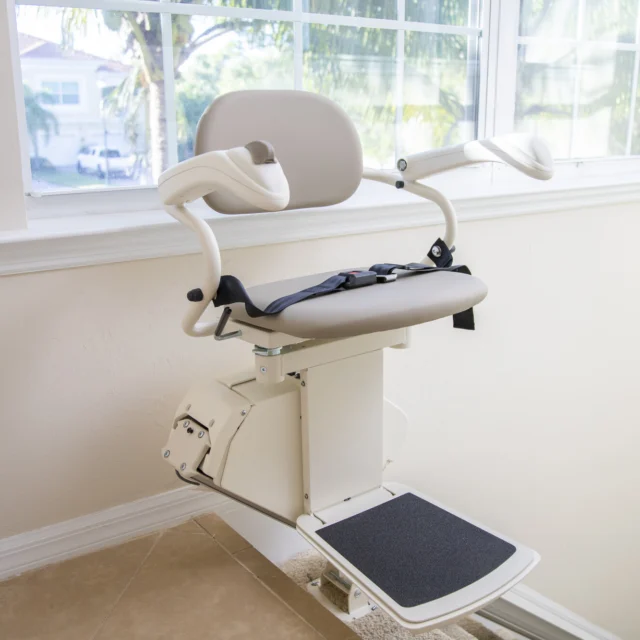
The Harmar SL300 is the entry-level model in Harmar’s Pinnacle line and is a good option for narrow staircases because of its rail design.
The rail mounts just 1 inch from the wall and is only 3 inches tall, making it one of the smallest rail footprints available.
The folded chair width is 11 inches, a bit wider than the SL600, but still one of the most compact seated options.
- Folded width: 11 inches (13.6 inches with optional folding rail)
- Rail-to-wall distance: About 1 inch
- Rail height: 3 inches
- Weight capacity: 300 pounds
- Battery backup: Up to 40 trips
- Minimum staircase width: About 28 inches
- Best for: Homeowners with narrow straight staircases who want the lowest-profile rail installation available at an accessible price point
Handicare 1000 — Perch Seat Configuration
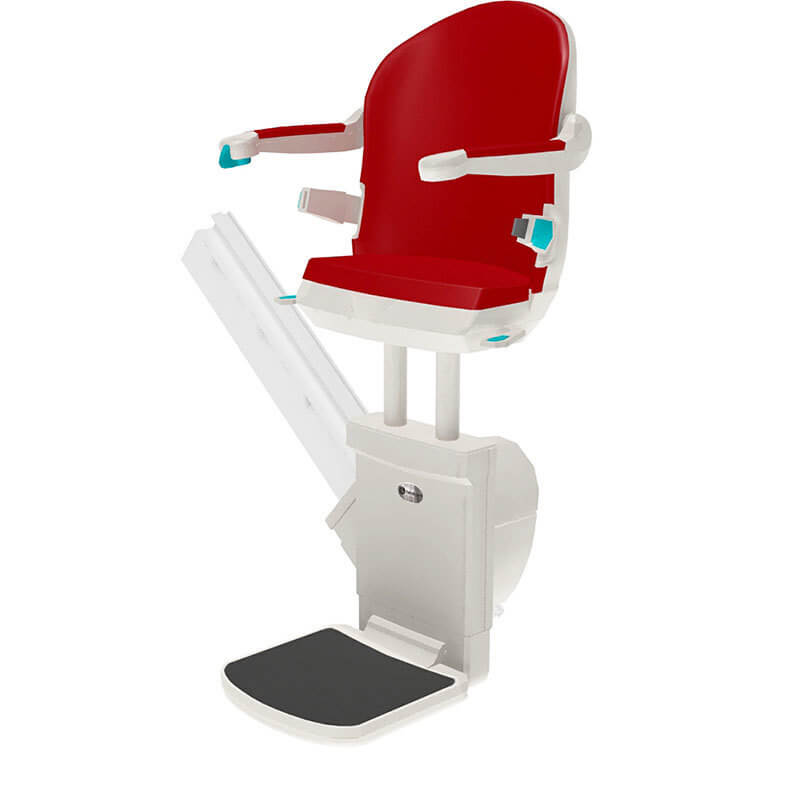
The Handicare 1000 with its perch seat is a good option for narrow staircases where a standard seated model might be too wide. However, you should check the specs carefully. The perch seat’s minimum folded width to the footplate is 15.15 inches, which is wider than the seated models above.
The main advantage of the perch setup is the riding position. Because the user is almost standing, their knees do not stick out like they would in a regular seat, so you need less clearance while the lift is moving.
If you are deciding whether a perch/standing model is the right fit, see our full Standing Stairlifts guide for a detailed breakdown of who this type is best suited for and what to expect.
- Minimum folded width (to footplate): 15.15 inches
- Minimum open width (to edge of footplate): 25.59 inches
- Weight capacity (perch configuration): 300 pounds
- Minimum staircase width: About 26 to 27 inches in some configurations
- Best for: Users whose mobility needs specifically align with a perch-style seat and whose staircase geometry makes a fully seated model difficult to install or use safely
Stannah Sadler — Perch/Saddle-Style Configuration
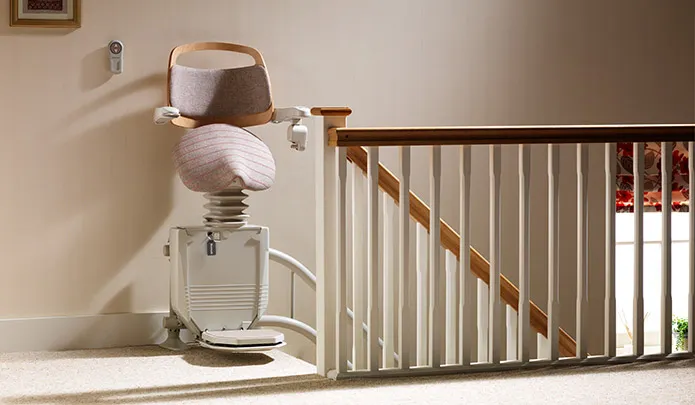
Unlike a conventional seated stairlift or a traditional perch seat, the Stannah Sadler uses a saddle-style seat that supports the rider in a nearly upright position — closer to standing than sitting — while bearing most of the user’s weight.
The saddle design was developed specifically for users who have limited hip or knee flexion and struggle to transition in and out of a seated position.
Because the user is nearly upright, the Sadler fits staircases as narrow as 26.5 inches, the tightest minimum of any model on this list. The knees-do-not-knock-the-banister advantage of the upright position is its primary dimensional benefit over a seated lift. The Sadler can be installed on both straight and curved staircase rails in the U.S., which is rare for a perch-style unit.
- Minimum staircase width: 26.5 inches
- Seat style: Saddle (partially standing, weight-bearing seat — not a conventional perch)
- Weight capacity: 300 pounds
- Battery backup: Up to 20 hours
- Rail compatibility: Straight and curved
- Best for: Users with limited hip or knee flexion who cannot comfortably use a fully seated lift, and whose staircase is too narrow for any standard seated option
Additional Notes and Considerations
- Folded width and minimum staircase width are not the same. The folded chair width shows how much space the unit takes up when parked against the wall. The minimum staircase width is the smallest staircase the manufacturer says the product will fit. This number includes space for safe passage and, for seated models, knee clearance during the ride.
- State and local codes may impose their own minimum passing widths. In Michigan, for example, the minimum passing width alongside a parked stairlift is 20 inches. A 28-inch staircase paired with the Harmar SL300 (11-inch folded width) would leave 17 inches of clearance, below that threshold. If local code applies, verify passing width requirements before selecting a model based on folded width alone.
- The folding rail option adds width at the base of the stairs. Both Harmar models can be equipped with an automatic folding rail that swings out of the way at the bottom landing. However, note that the folding rail increases the minimum folded width from 11 inches to 13.6 inches on the SL300, and from 10.5 inches to 13 inches on the SL600.
How to Measure Your Staircase for a Stairlift
Getting accurate measurements is important before you talk to dealers or compare models. Here’s what to measure and how to do it:
- Clear width is the most important measurement. Measure the distance from the wall on one side to the inside edge of any railing, baluster, or wall on the other. If your railing sticks out anywhere, measure from the wall to the inside edge of the railing where it sticks out the most.
- Stair depth is the horizontal distance from the front edge of one tread to the back of the same tread. Most residential stairs have a tread depth of 9 to 11 inches. Very shallow treads can affect rail mounting options on some models.
- Stair height is the vertical rise of each step. Most residential stairs rise 7 to 8 inches. Steeper stairs, which are common in older homes and basements, may limit which models will work and affect the rail angle you can use.
- Total staircase length is the distance from the bottom landing to the top landing along the slope of the staircase. This determines how much rail is needed and affects the overall installed cost.
- You should also note the landing dimensions at the top and bottom of the staircase. You need enough floor space at both ends for safe entry, exit, and parking the chair. Tight landings at the top of the stairs are a common challenge, especially where the stairs meet a hallway door.
Bring these measurements to your first meeting with a dealer. This helps them quickly see which models will work and saves time by ruling out options that will not fit before you schedule an in-home visit.
What If Your Staircase Is Too Narrow?
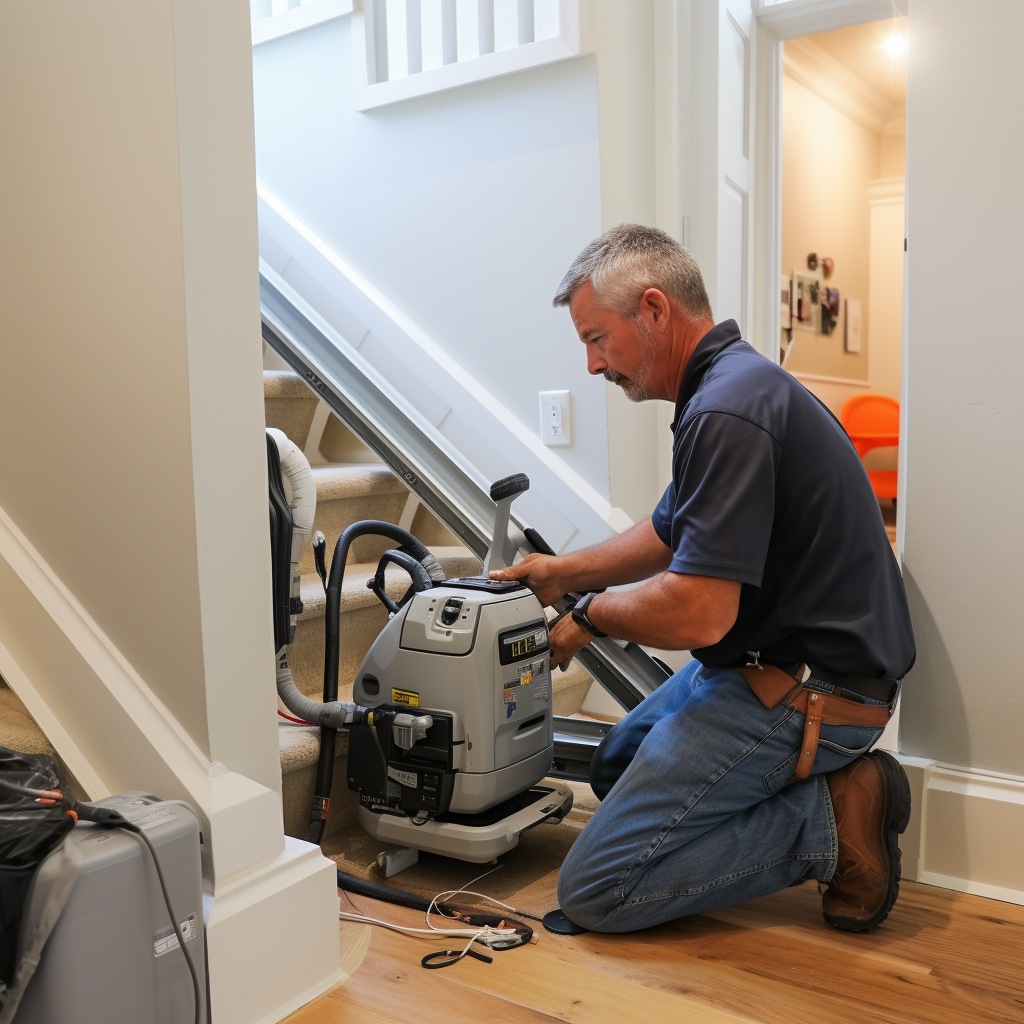
If your staircase is narrower than the minimum width for most standard stairlift models, usually below 26 to 28 inches, your options are fewer but not gone completely.
- Changing the railing is the most common fix. Often, you can replace a standard railing with a slimmer or wall-mounted handrail to gain a few extra inches of width.
- Wall-mounted rail systems on some stairlift models mount the rail directly to the wall rather than the stair treads. This can reduce the footprint on the staircase surface and, in some cases, allow installation in slightly narrower spaces. Not all models offer this option, so confirm availability with your installer.
- Widening the staircase is a bigger structural change and can be costly. However, it is worth considering if no stairlift fits and you plan to stay in your home long-term.
- Vertical platform lifts are another option if your staircase cannot fit any stairlift model. These lifts go straight up and down instead of following the stairs, so they do not need any staircase width and can be used by people in wheelchairs.
- Home elevators are the most complete solution if your staircase cannot fit a stairlift. They provide smooth access between floors and can carry wheelchairs and several people, but they are much more expensive and require major construction.
Local stairlift pros can determine if your staircase is stairlift-compatible. Get connected today!
Staircase Width and Household Access
Homeowners with narrow stairs sometimes forget to think about how a stairlift will affect other people’s ability to use the stairs. Most building codes require at least 20 inches of clear space next to a parked stairlift. After the lift is folded, there must still be at least 20 inches left for people to pass.
For example, if you have a 28-inch staircase and a stairlift that folds to 12 inches, you will have 16 inches left, which is less than the 20-inch minimum in most places. Be sure to talk about this with your installer before buying, both for code compliance and for everyday use.
Some homeowners solve this by choosing a stairlift that parks completely at the top or bottom of the stairs, off the steps themselves. This way, the full width of the stairs is open for others when the lift is parked. Ask your installer about parking options when looking at models for narrow staircases.
The Importance of an In-Home Assessment
For standard staircases, a general quote based on your measurements is usually enough to get started. For narrow staircases, it is strongly recommended, and often necessary, to have a certified installer do an in-home assessment before you buy any specific model.
A professional assessment:
- Confirms exact clearance dimensions at the narrowest point of the staircase
- Evaluates landing space at the top and bottom
- Identifies any railing or architectural features that affect installation
- Assesses whether railing modification would meaningfully expand your options
- Confirms code compliance requirements for your specific municipality
- Rules out models that look compatible on paper but have clearance issues that only become apparent on-site
Modernize can connect you with trusted local stairlift installers in your area who can assess your staircase and recommend the best solution for your needs.